
tc3 97 61.pdf
Vista previa de texto
Chapter 3
HARNESSES
3-17. Years ago climbers secured themselves to the rope by wrapping the rope around their bodies and
tying a bowline-on-a-coil. While this technique is still a viable way of attaching to a rope, the practice is no
longer encouraged due to the increased possibility of injury from a fall. The bowline-on-a-coil is best left
for low-angle climbing or an emergency situation where harness material is unavailable. Climbers today
can select from a wide range of manufactured harnesses. Fitted properly, the harness should ride high on
the hips and have snug leg loops to better distribute the force of a fall to the entire pelvis. This type of
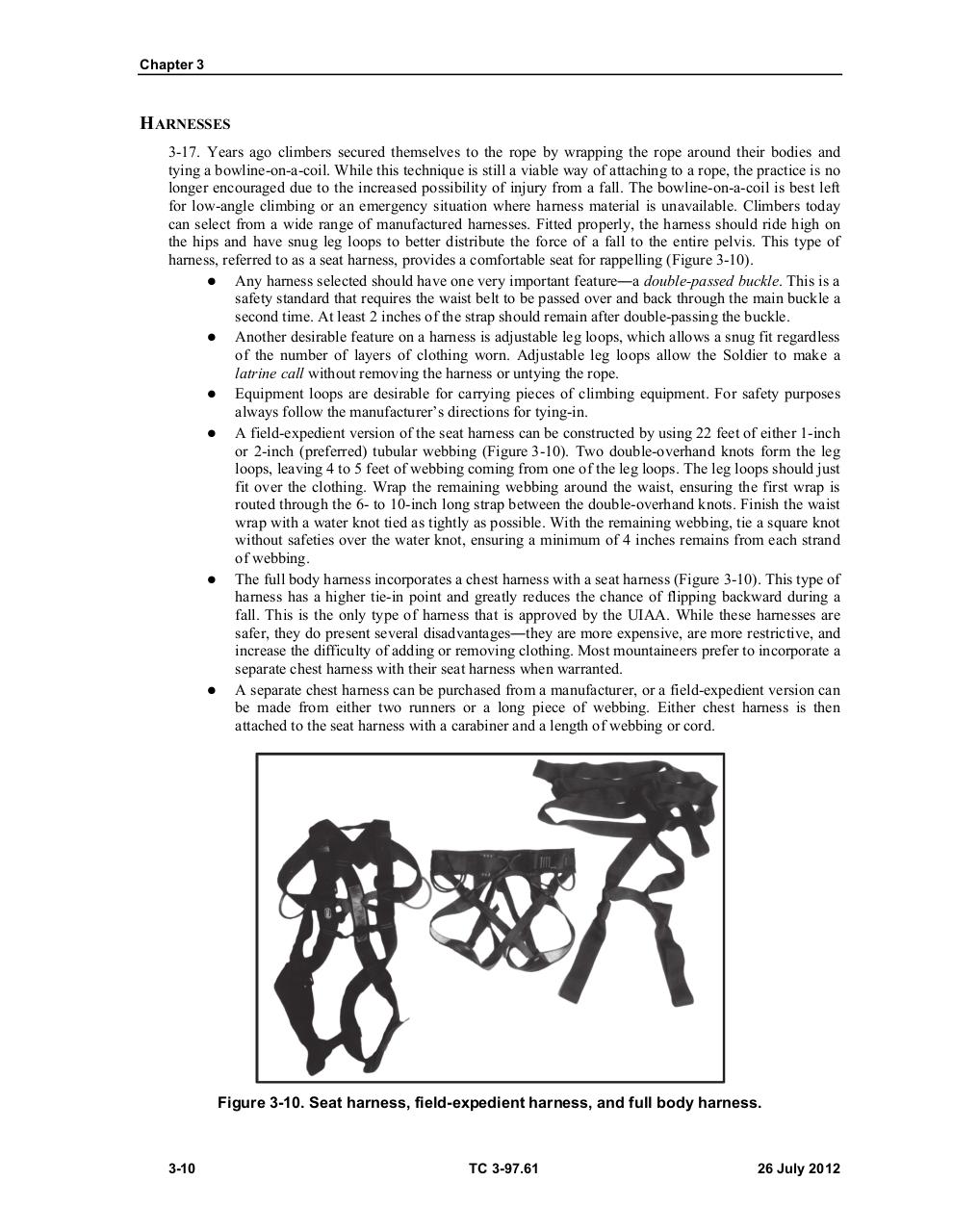
harness, referred to as a seat harness, provides a comfortable seat for rappelling (Figure 3-10).
Any harness selected should have one very important feature―a double-passed buckle. This is a
safety standard that requires the waist belt to be passed over and back through the main buckle a
second time. At least 2 inches of the strap should remain after double-passing the buckle.
Another desirable feature on a harness is adjustable leg loops, which allows a snug fit regardless
of the number of layers of clothing worn. Adjustable leg loops allow the Soldier to make a
latrine call without removing the harness or untying the rope.
Equipment loops are desirable for carrying pieces of climbing equipment. For safety purposes
always follow the manufacturer’s directions for tying-in.
A field-expedient version of the seat harness can be constructed by using 22 feet of either 1-inch
or 2-inch (preferred) tubular webbing (Figure 3-10). Two double-overhand knots form the leg
loops, leaving 4 to 5 feet of webbing coming from one of the leg loops. The leg loops should just
fit over the clothing. Wrap the remaining webbing around the waist, ensuring the first wrap is
routed through the 6- to 10-inch long strap between the double-overhand knots. Finish the waist
wrap with a water knot tied as tightly as possible. With the remaining webbing, tie a square knot
without safeties over the water knot, ensuring a minimum of 4 inches remains from each strand
of webbing.
The full body harness incorporates a chest harness with a seat harness (Figure 3-10). This type of
harness has a higher tie-in point and greatly reduces the chance of flipping backward during a
fall. This is the only type of harness that is approved by the UIAA. While these harnesses are
safer, they do present several disadvantages―they are more expensive, are more restrictive, and
increase the difficulty of adding or removing clothing. Most mountaineers prefer to incorporate a
separate chest harness with their seat harness when warranted.
A separate chest harness can be purchased from a manufacturer, or a field-expedient version can
be made from either two runners or a long piece of webbing. Either chest harness is then
attached to the seat harness with a carabiner and a length of webbing or cord.
Figure 3-10. Seat harness, field-expedient harness, and full body harness.
3-10
TC 3-97.61
26 July 2012