
tc3 97 61.pdf
Vista previa de texto
Chapter 3
MAINTENANCE OF CLOTHING
3-13. Clothing and equipment manufacturers provide specific instructions for proper care. Following these
instructions is necessary to ensure the equipment works as intended.
CLIMBING SOFTWARE
3-14. Climbing software refers to rope, cord, webbing, and harnesses. All mountaineering specific
equipment, to include hardware (see paragraph 3-4), should only be used if it has the UIAA certificate of
safety. UIAA is the organization that oversees the testing of mountaineering equipment. It is based in Paris,
France, and comprises several commissions. The safety commission has established standards for
mountaineering and climbing equipment that have become well recognized throughout the world. Their
work continues as new equipment develops and is brought into common use. Community Europe (CE)
recognizes UIAA testing standards and, as the broader-based testing facility for the combined European
economy, meets or exceeds the UIAA standards for all climbing and mountaineering equipment produced
in Europe. European norm (EN) and CE have been combined to make combined European norm (CEN).
While the United States has no specific standards, American manufacturers have their equipment tested by
UIAA to ensure safe operating tolerances.
ROPES AND CORD
3-15. Ropes and cords are the most important pieces of mountaineering equipment and proper selection
deserves careful thought. These items are your lifeline in the mountains, so selecting the right type and size
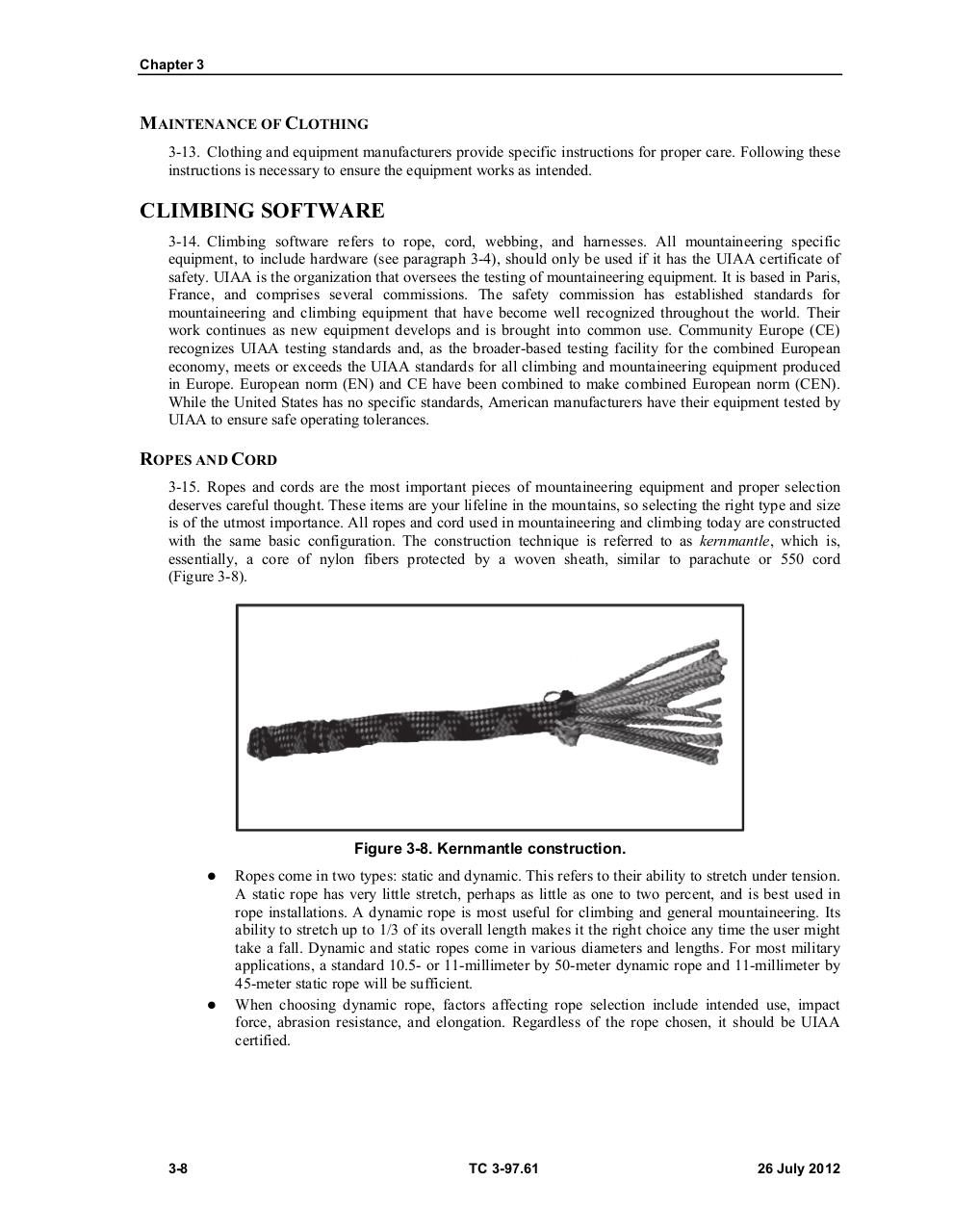
is of the utmost importance. All ropes and cord used in mountaineering and climbing today are constructed
with the same basic configuration. The construction technique is referred to as kernmantle, which is,
essentially, a core of nylon fibers protected by a woven sheath, similar to parachute or 550 cord
(Figure 3-8).
Figure 3-8. Kernmantle construction.
3-8
Ropes come in two types: static and dynamic. This refers to their ability to stretch under tension.
A static rope has very little stretch, perhaps as little as one to two percent, and is best used in
rope installations. A dynamic rope is most useful for climbing and general mountaineering. Its
ability to stretch up to 1/3 of its overall length makes it the right choice any time the user might
take a fall. Dynamic and static ropes come in various diameters and lengths. For most military
applications, a standard 10.5- or 11-millimeter by 50-meter dynamic rope and 11-millimeter by
45-meter static rope will be sufficient.
When choosing dynamic rope, factors affecting rope selection include intended use, impact
force, abrasion resistance, and elongation. Regardless of the rope chosen, it should be UIAA
certified.
TC 3-97.61
26 July 2012