
tc3 97 61.pdf
Vista previa de texto
Mountaineering Equipment
Cord or small diameter rope is indispensable to the mountaineer. Its many uses make it a
valuable piece of equipment. All cord is static and constructed in the same manner as larger
rope. If used for Prusik knots, the cord’s diameter should be 5 to 7 millimeters when used on an
11-mm rope.
WEBBING AND SLINGS
3-16. Loops of tubular webbing or cord, called slings or runners, are the simplest pieces of equipment and
some of the most useful. The uses for these simple pieces are endless, and they are a critical link between
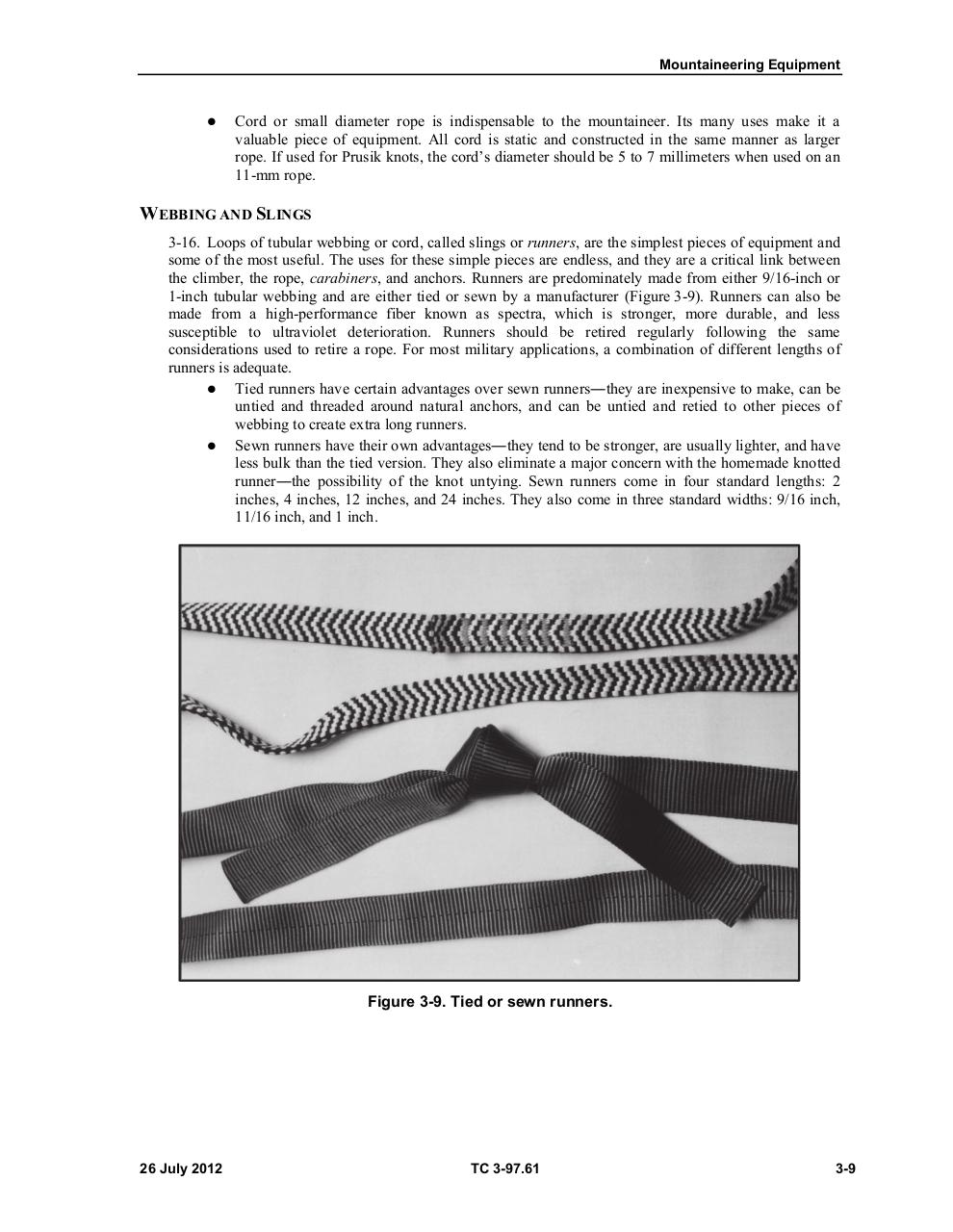
the climber, the rope, carabiners, and anchors. Runners are predominately made from either 9/16-inch or
1-inch tubular webbing and are either tied or sewn by a manufacturer (Figure 3-9). Runners can also be
made from a high-performance fiber known as spectra, which is stronger, more durable, and less
susceptible to ultraviolet deterioration. Runners should be retired regularly following the same
considerations used to retire a rope. For most military applications, a combination of different lengths of
runners is adequate.
Tied runners have certain advantages over sewn runners―they are inexpensive to make, can be
untied and threaded around natural anchors, and can be untied and retied to other pieces of
webbing to create extra long runners.
Sewn runners have their own advantages―they tend to be stronger, are usually lighter, and have
less bulk than the tied version. They also eliminate a major concern with the homemade knotted
runner―the possibility of the knot untying. Sewn runners come in four standard lengths: 2
inches, 4 inches, 12 inches, and 24 inches. They also come in three standard widths: 9/16 inch,
11/16 inch, and 1 inch.
Figure 3-9. Tied or sewn runners.
26 July 2012
TC 3-97.61
3-9