
tc3 97 61.pdf
Vista previa de texto
Mountaineering Equipment
CLIMBING HARDWARE
3-18. Climbing hardware refers to all the parts and pieces that allow the trained mountain Soldier to
accomplish many tasks in the mountains. The importance of this gear to the mountaineer is no less than that
of the rifle to the Infantryman.
CARABINERS
3-19. One of the most versatile pieces of equipment available to the mountaineer is the carabiner. This
simple piece of gear is the critical connection between the climber, his rope, and the protection attaching
him to the mountain. Carabiners must be strong enough to hold hard falls, yet light enough for the climber
to easily carry a quantity of them. Today’s high tech metal alloys allow carabiners to meet both of these
requirements. Steel is still widely used, but is not preferred for general mountaineering, given other options.
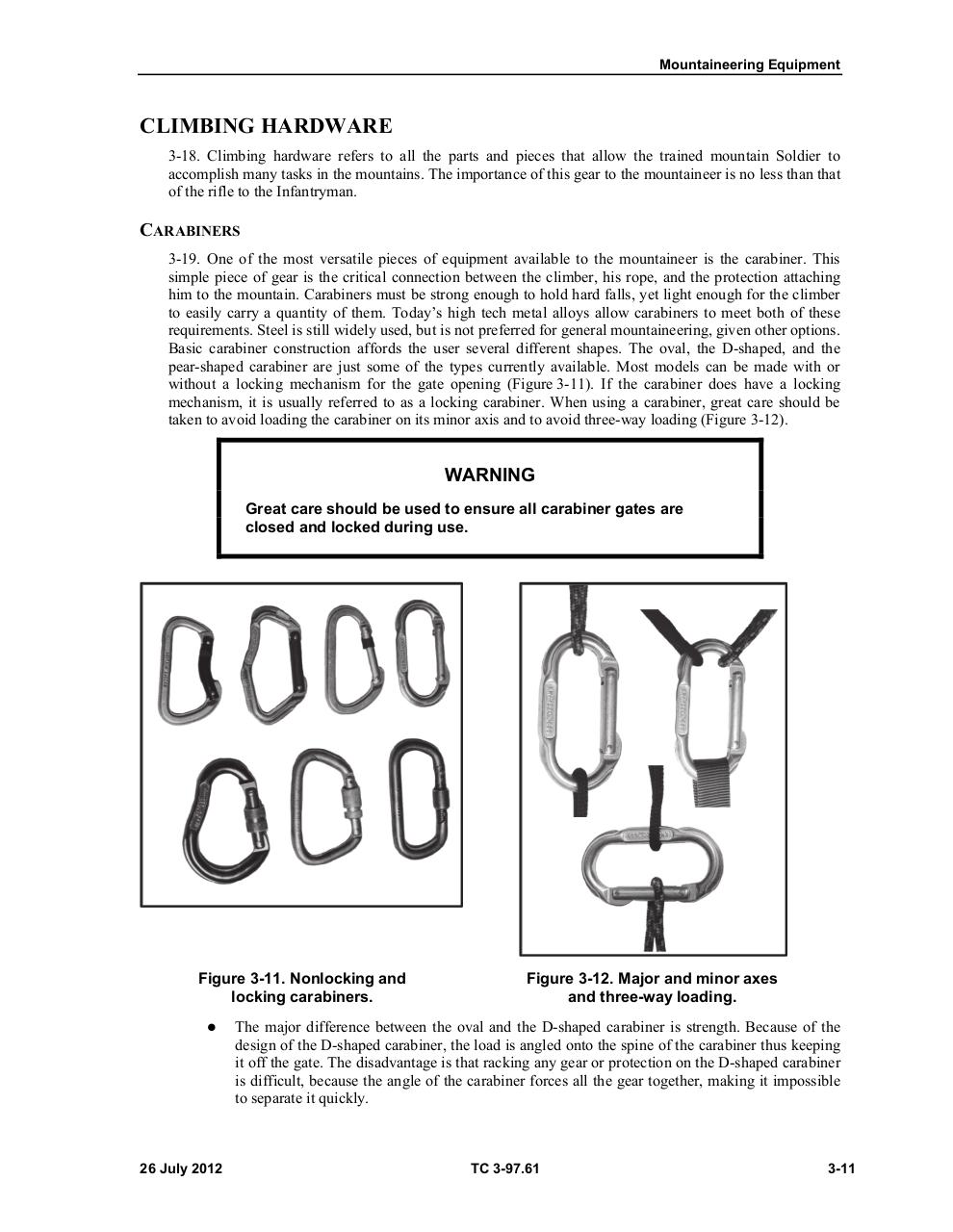
Basic carabiner construction affords the user several different shapes. The oval, the D-shaped, and the
pear-shaped carabiner are just some of the types currently available. Most models can be made with or
without a locking mechanism for the gate opening (Figure 3-11). If the carabiner does have a locking
mechanism, it is usually referred to as a locking carabiner. When using a carabiner, great care should be
taken to avoid loading the carabiner on its minor axis and to avoid three-way loading (Figure 3-12).
WARNING
Great care should be used to ensure all carabiner gates are
closed and locked during use.
Figure 3-11. Nonlocking and
locking carabiners.
26 July 2012
Figure 3-12. Major and minor axes
and three-way loading.
The major difference between the oval and the D-shaped carabiner is strength. Because of the
design of the D-shaped carabiner, the load is angled onto the spine of the carabiner thus keeping
it off the gate. The disadvantage is that racking any gear or protection on the D-shaped carabiner
is difficult, because the angle of the carabiner forces all the gear together, making it impossible
to separate it quickly.
TC 3-97.61
3-11