
How to design for your brand(1).pdf
Vista previa de texto
COLOR GROUPS
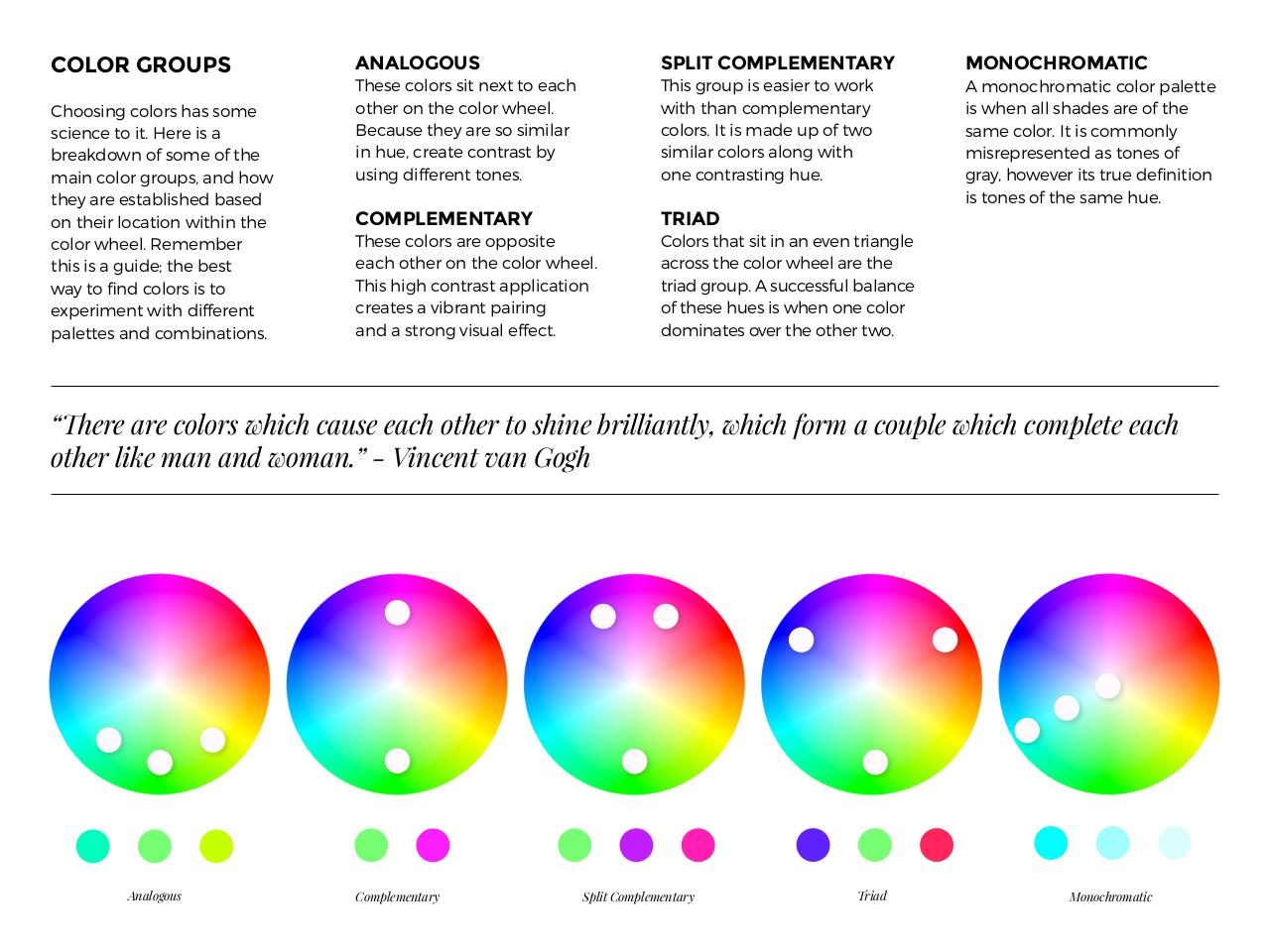
ANALOGOUS
SPLIT COMPLEMENTARY
MONOCHROMATIC
Choosing colors has some
science to it. Here is a
breakdown of some of the
main color groups, and how
they are established based
on their location within the
color wheel. Remember
this is a guide; the best
way to find colors is to
experiment with different
palettes and combinations.
These colors sit next to each
other on the color wheel.
Because they are so similar
in hue, create contrast by
using different tones.
This group is easier to work
with than complementary
colors. It is made up of two
similar colors along with
one contrasting hue.
COMPLEMENTARY
TRIAD
A monochromatic color palette
is when all shades are of the
same color. It is commonly
misrepresented as tones of
gray, however its true definition
is tones of the same hue.
These colors are opposite
each other on the color wheel.
This high contrast application
creates a vibrant pairing
and a strong visual effect.
Colors that sit in an even triangle
across the color wheel are the
triad group. A successful balance
of these hues is when one color
dominates over the other two.
I!(1($31($=,*,1#$)+"=+$=3&#($(3=+$,.+(1$.,$#+"/($21"**"3/.*-P$)+"=+$0,1:$3$=,&<*($)+"=+$=,:<*(.($(3=+$
,.+(1$*"A($:3/$3/'$),:3/6J$E$Q"/=(/.$53/$R,%+
9/3*,%,&#
4,:<*(:(/.31-
><*".$4,:<*(:(/.31-
S1"3'
G,/,=+1,:3."=