
tc3 97 61.pdf
Vista previa de texto
Chapter 3
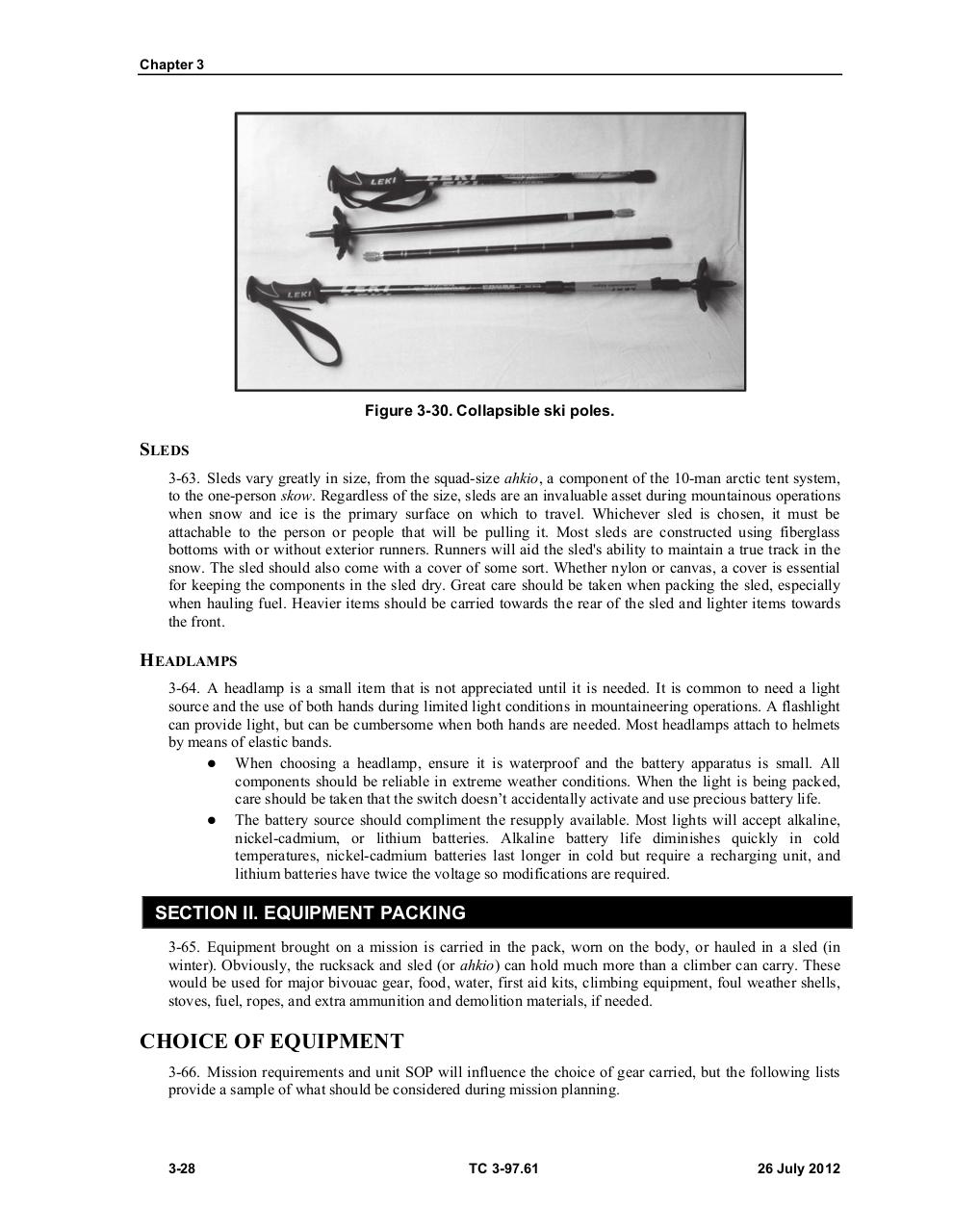
Figure 3-30. Collapsible ski poles.
SLEDS
3-63. Sleds vary greatly in size, from the squad-size ahkio, a component of the 10-man arctic tent system,
to the one-person skow. Regardless of the size, sleds are an invaluable asset during mountainous operations
when snow and ice is the primary surface on which to travel. Whichever sled is chosen, it must be
attachable to the person or people that will be pulling it. Most sleds are constructed using fiberglass
bottoms with or without exterior runners. Runners will aid the sled's ability to maintain a true track in the
snow. The sled should also come with a cover of some sort. Whether nylon or canvas, a cover is essential
for keeping the components in the sled dry. Great care should be taken when packing the sled, especially
when hauling fuel. Heavier items should be carried towards the rear of the sled and lighter items towards
the front.
HEADLAMPS
3-64. A headlamp is a small item that is not appreciated until it is needed. It is common to need a light
source and the use of both hands during limited light conditions in mountaineering operations. A flashlight
can provide light, but can be cumbersome when both hands are needed. Most headlamps attach to helmets
by means of elastic bands.
When choosing a headlamp, ensure it is waterproof and the battery apparatus is small. All
components should be reliable in extreme weather conditions. When the light is being packed,
care should be taken that the switch doesn’t accidentally activate and use precious battery life.
The battery source should compliment the resupply available. Most lights will accept alkaline,
nickel-cadmium, or lithium batteries. Alkaline battery life diminishes quickly in cold
temperatures, nickel-cadmium batteries last longer in cold but require a recharging unit, and
lithium batteries have twice the voltage so modifications are required.
SECTION II. EQUIPMENT PACKING
3-65. Equipment brought on a mission is carried in the pack, worn on the body, or hauled in a sled (in
winter). Obviously, the rucksack and sled (or ahkio) can hold much more than a climber can carry. These
would be used for major bivouac gear, food, water, first aid kits, climbing equipment, foul weather shells,
stoves, fuel, ropes, and extra ammunition and demolition materials, if needed.
CHOICE OF EQUIPMENT
3-66. Mission requirements and unit SOP will influence the choice of gear carried, but the following lists
provide a sample of what should be considered during mission planning.
3-28
TC 3-97.61
26 July 2012