
tc3 97 61.pdf
Vista previa de texto
Chapter 3
PULLEYS
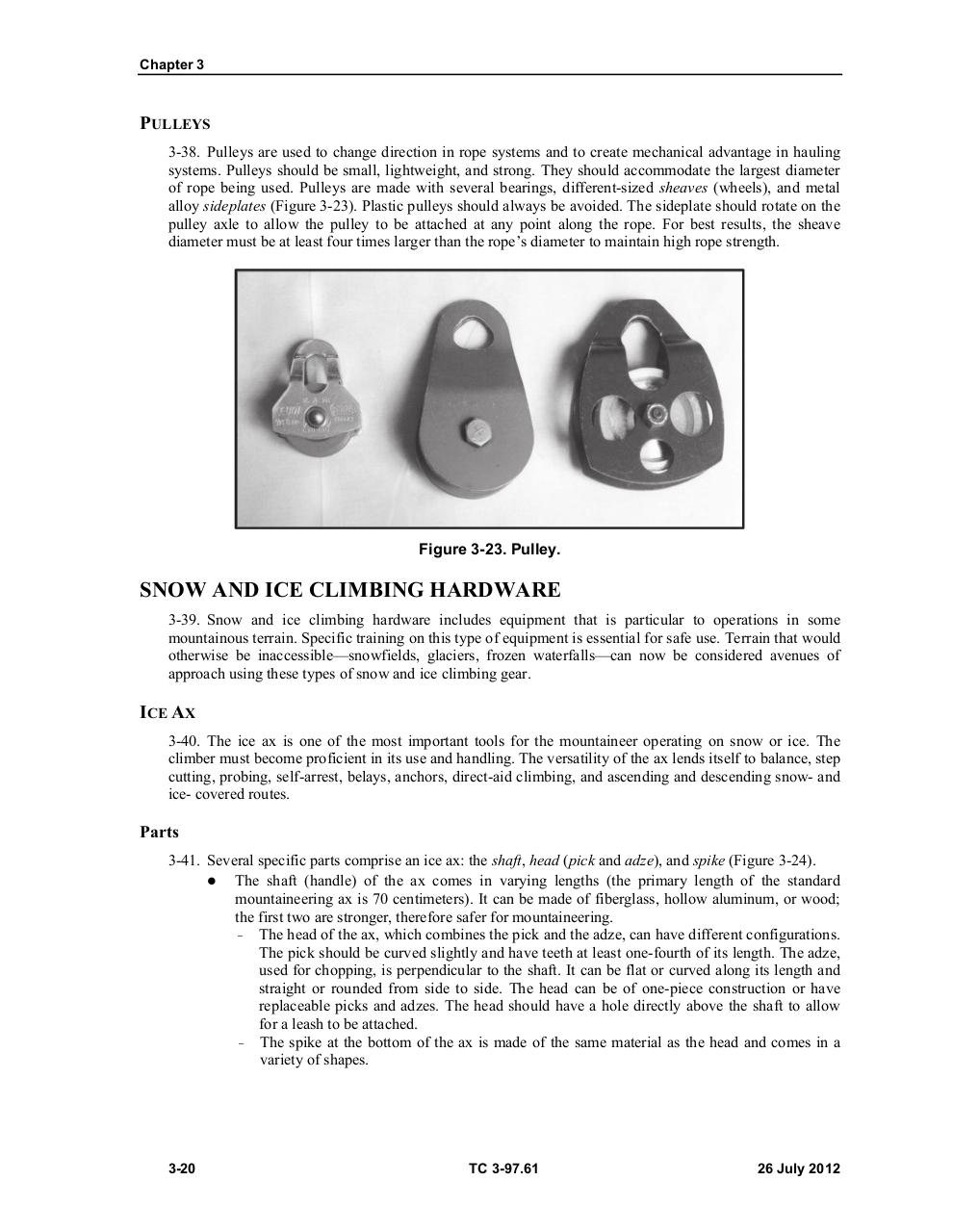
3-38. Pulleys are used to change direction in rope systems and to create mechanical advantage in hauling
systems. Pulleys should be small, lightweight, and strong. They should accommodate the largest diameter
of rope being used. Pulleys are made with several bearings, different-sized sheaves (wheels), and metal
alloy sideplates (Figure 3-23). Plastic pulleys should always be avoided. The sideplate should rotate on the
pulley axle to allow the pulley to be attached at any point along the rope. For best results, the sheave
diameter must be at least four times larger than the rope’s diameter to maintain high rope strength.
Figure 3-23. Pulley.
SNOW AND ICE CLIMBING HARDWARE
3-39. Snow and ice climbing hardware includes equipment that is particular to operations in some
mountainous terrain. Specific training on this type of equipment is essential for safe use. Terrain that would
otherwise be inaccessible—snowfields, glaciers, frozen waterfalls—can now be considered avenues of
approach using these types of snow and ice climbing gear.
ICE AX
3-40. The ice ax is one of the most important tools for the mountaineer operating on snow or ice. The
climber must become proficient in its use and handling. The versatility of the ax lends itself to balance, step
cutting, probing, self-arrest, belays, anchors, direct-aid climbing, and ascending and descending snow- and
ice- covered routes.
Parts
3-41. Several specific parts comprise an ice ax: the shaft, head (pick and adze), and spike (Figure 3-24).
The shaft (handle) of the ax comes in varying lengths (the primary length of the standard
mountaineering ax is 70 centimeters). It can be made of fiberglass, hollow aluminum, or wood;
the first two are stronger, therefore safer for mountaineering.
—
The head of the ax, which combines the pick and the adze, can have different configurations.
The pick should be curved slightly and have teeth at least one-fourth of its length. The adze,
used for chopping, is perpendicular to the shaft. It can be flat or curved along its length and
straight or rounded from side to side. The head can be of one-piece construction or have
replaceable picks and adzes. The head should have a hole directly above the shaft to allow
for a leash to be attached.
—
The spike at the bottom of the ax is made of the same material as the head and comes in a
variety of shapes.
3-20
TC 3-97.61
26 July 2012