
tc3 97 61.pdf
Vista previa de texto
Chapter 3
CHOCKS
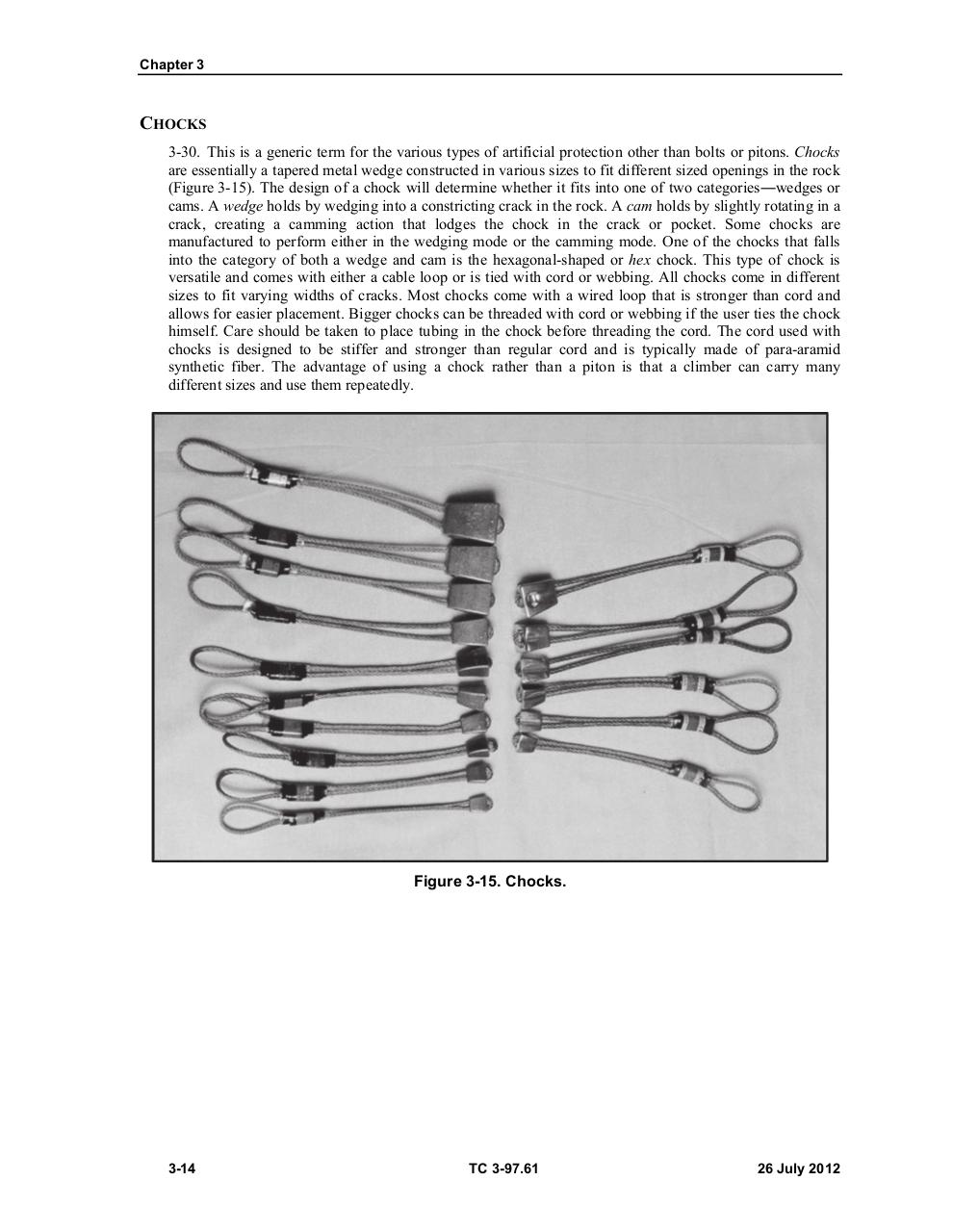
3-30. This is a generic term for the various types of artificial protection other than bolts or pitons. Chocks
are essentially a tapered metal wedge constructed in various sizes to fit different sized openings in the rock
(Figure 3-15). The design of a chock will determine whether it fits into one of two categories―wedges or
cams. A wedge holds by wedging into a constricting crack in the rock. A cam holds by slightly rotating in a
crack, creating a camming action that lodges the chock in the crack or pocket. Some chocks are
manufactured to perform either in the wedging mode or the camming mode. One of the chocks that falls
into the category of both a wedge and cam is the hexagonal-shaped or hex chock. This type of chock is
versatile and comes with either a cable loop or is tied with cord or webbing. All chocks come in different
sizes to fit varying widths of cracks. Most chocks come with a wired loop that is stronger than cord and
allows for easier placement. Bigger chocks can be threaded with cord or webbing if the user ties the chock
himself. Care should be taken to place tubing in the chock before threading the cord. The cord used with
chocks is designed to be stiffer and stronger than regular cord and is typically made of para-aramid
synthetic fiber. The advantage of using a chock rather than a piton is that a climber can carry many
different sizes and use them repeatedly.
Figure 3-15. Chocks.
3-14
TC 3-97.61
26 July 2012