
FuturENVIRO Noviembre .pdf
Vista previa de texto
the wastewater but removing the contaminants), as well as
facilitating technical improvements in irrigation systems and the
production of crops with a higher added value.
A continuación se describen, el sistema de drenaje del Valle de México, del cual la PTAR Atotonilco forma parte y, se analizan con detalle los objetivos, caudales a tratar, calidad del influente y efluente
así como las líneas de tratamiento de agua.
This report provides an outline of the sewage system in the
Valley of Mexico, of which the Atotonilco WWTP forms part,
as well as a detailed description of the objectives, raw water
inflows, effluent and water treatment lines of the plant.
SISTEMA DE DRENAJE
SEWAGE SYSTEM
La zona Metropolitana del Valle de México está asentada sobre un
antiguo sistema lacustre, compuesto por cinco grandes lagos, los
cuales, durante las épocas de lluvia crecían al punto de unirse en un
único gran lago. Desde la fundación de los primeros asentamientos
alrededor de estos lagos, las poblaciones han sufrido severos problemas para evitar las inundaciones producto de las lluvias.
The metropolitan area of the Valley of Mexico is located on an
old lake system, made up of five large lakes, the levels of which,
in times of heavy rainfall, rise to the point where they form a
single large lake. Since the time of the first settlements around
these lakes, the towns have suffered severe problems of flooding.
Actualmente, el Valle de México, una cuenca originalmente cerrada, exporta caudales considerables de aguas de lluvia y aguas residuales al vecino Valle del Mezquital en el Estado de Hidalgo. La ciudad de México tiene un sistema de drenaje combinado. Las lluvias
son estacionales, el 85% de la precipitación anual cae en sólo cinco
meses del año (Junio-Octubre) con fuertes fluctuaciones estacionales en el caudal de aguas residuales.
Las descargas de aguas residuales a la red de drenaje se estiman
entre 41 m3/s y 44 m3/s en promedio en las épocas de lluvias y estiaje, respectivamente, incluyendo una aportación por descargas
industriales del orden de 3 m3/s. Descontando las extracciones de
agua residual para reutilización urbana-industrial dentro de la
cuenca de México y sumando las aportaciones de agua pluvial,
los gastos totales manejados por el sistema de drenaje de la Zona
Metropolitana del Valle de México promedian entre 46 m3/s y 74
m3/s, en estiaje y lluvias, respectivamente, de los cuales se extraen
para riego agrícola dentro del Valle de México de 7.6 m3/s a 3.4
m3/s en estiaje y lluvias, lo que da como resultado las exportaciones fuera de la Cuenca de México: 38.5 m3/s y 70,1 m3/s en estiaje
y lluvias, respectivamente. Las exportaciones tienen lugar por dos
sitios: El río Salado que recibe las aguas del Gran Canal y El río El
Salto que recibe las aguas del Emisor Central y el Emisor Poniente.
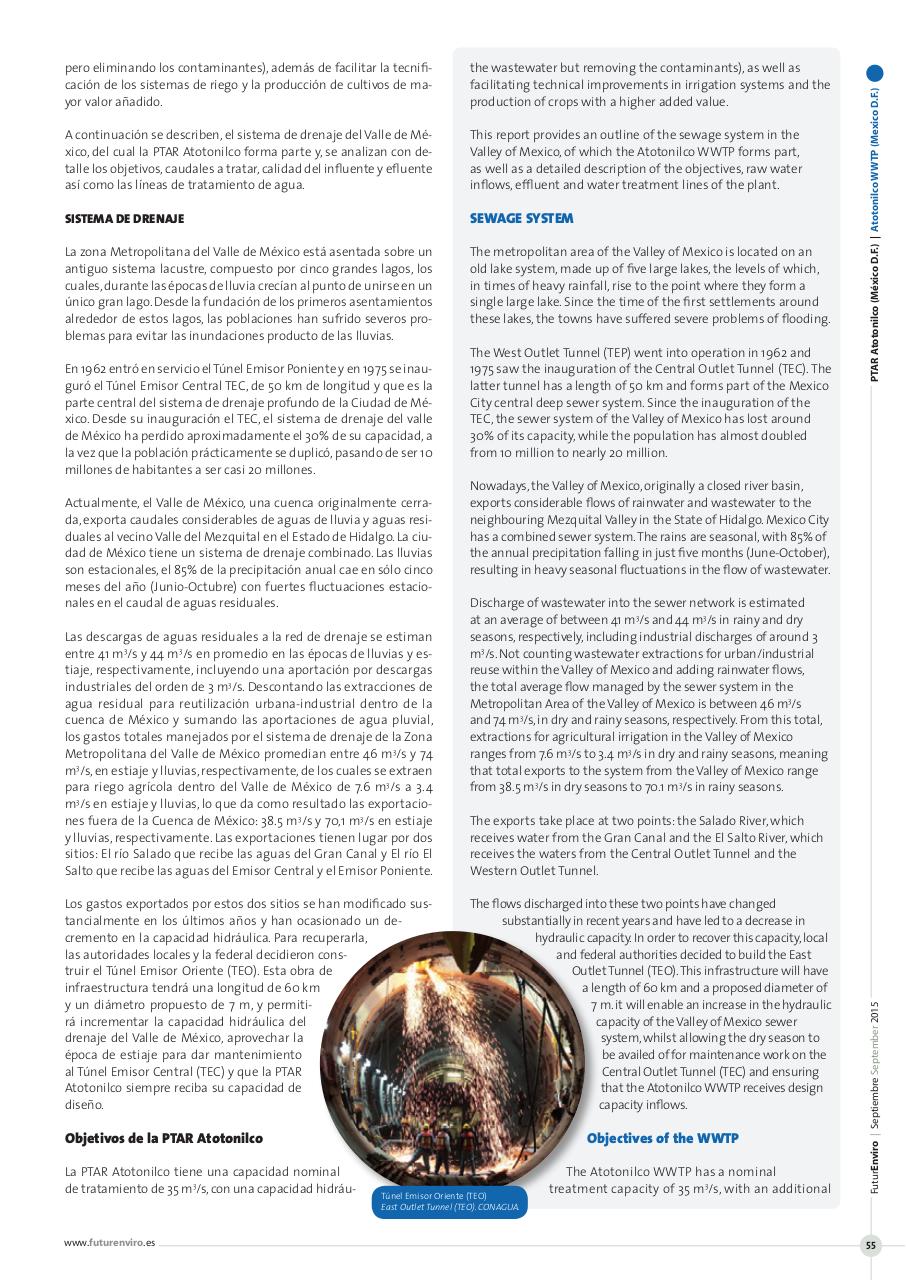
Los gastos exportados por estos dos sitios se han modificado sustancialmente en los últimos años y han ocasionado un decremento en la capacidad hidráulica. Para recuperarla,
las autoridades locales y la federal decidieron construir el Túnel Emisor Oriente (TEO). Esta obra de
infraestructura tendrá una longitud de 60 km
y un diámetro propuesto de 7 m, y permitirá incrementar la capacidad hidráulica del
drenaje del Valle de México, aprovechar la
época de estiaje para dar mantenimiento
al Túnel Emisor Central (TEC) y que la PTAR
Atotonilco siempre reciba su capacidad de
diseño.
The West Outlet Tunnel (TEP) went into operation in 1962 and
1975 saw the inauguration of the Central Outlet Tunnel (TEC). The
latter tunnel has a length of 50 km and forms part of the Mexico
City central deep sewer system. Since the inauguration of the
TEC, the sewer system of the Valley of Mexico has lost around
30% of its capacity, while the population has almost doubled
from 10 million to nearly 20 million.
Nowadays, the Valley of Mexico, originally a closed river basin,
exports considerable flows of rainwater and wastewater to the
neighbouring Mezquital Valley in the State of Hidalgo. Mexico City
has a combined sewer system. The rains are seasonal, with 85% of
the annual precipitation falling in just five months (June-October),
resulting in heavy seasonal fluctuations in the flow of wastewater.
Discharge of wastewater into the sewer network is estimated
at an average of between 41 m3/s and 44 m3/s in rainy and dry
seasons, respectively, including industrial discharges of around 3
m3/s. Not counting wastewater extractions for urban/industrial
reuse within the Valley of Mexico and adding rainwater flows,
the total average flow managed by the sewer system in the
Metropolitan Area of the Valley of Mexico is between 46 m3/s
and 74 m3/s, in dry and rainy seasons, respectively. From this total,
extractions for agricultural irrigation in the Valley of Mexico
ranges from 7.6 m3/s to 3.4 m3/s in dry and rainy seasons, meaning
that total exports to the system from the Valley of Mexico range
from 38.5 m3/s in dry seasons to 70.1 m3/s in rainy seasons.
The exports take place at two points: the Salado River, which
receives water from the Gran Canal and the El Salto River, which
receives the waters from the Central Outlet Tunnel and the
Western Outlet Tunnel.
The flows discharged into these two points have changed
substantially in recent years and have led to a decrease in
hydraulic capacity. In order to recover this capacity, local
and federal authorities decided to build the East
Outlet Tunnel (TEO). This infrastructure will have
a length of 60 km and a proposed diameter of
7 m. it will enable an increase in the hydraulic
capacity of the Valley of Mexico sewer
system, whilst allowing the dry season to
be availed of for maintenance work on the
Central Outlet Tunnel (TEC) and ensuring
that the Atotonilco WWTP receives design
capacity inflows.
Objectives of the WWTP
Objetivos de la PTAR Atotonilco
La PTAR Atotonilco tiene una capacidad nominal
de tratamiento de 35 m3/s, con una capacidad hidráu-
www.futurenviro.es
Túnel Emisor Oriente (TEO)
East Outlet Tunnel (TEO). CONAGUA.
The Atotonilco WWTP has a nominal
treatment capacity of 35 m3/s, with an additional
FuturEnviro | Septiembre September 2015
En 1962 entró en servicio el Túnel Emisor Poniente y en 1975 se inauguró el Túnel Emisor Central TEC, de 50 km de longitud y que es la
parte central del sistema de drenaje profundo de la Ciudad de México. Desde su inauguración el TEC, el sistema de drenaje del valle
de México ha perdido aproximadamente el 30% de su capacidad, a
la vez que la población prácticamente se duplicó, pasando de ser 10
millones de habitantes a ser casi 20 millones.
PTAR Atotonilco (México D.F.) | Atotonilco WWTP (Mexico D.F.)
pero eliminando los contaminantes), además de facilitar la tecnificación de los sistemas de riego y la producción de cultivos de mayor valor añadido.
55