
FuturENVIRO Noviembre .pdf
Vista previa de texto
Se trata de un consorcio formado por Acciona Agua, Promotora del Desarrollo de América Latina, S.A. de C.V., Controladora de
Operaciones de Infraestructura, S.A. de C.V. (ICA); Atlatec, S.A. de
C.V; Desarrollo y Construcciones Urbanas, S.A. de C.V. y Green Gas
Pioneer Crossing Energy, LLC. El contrato firmado establece la
prestación de los servicios de diseño, elaboración del proyecto,
construcción y tratamiento de aguas residuales del Valle de México por 25 años.
El contrato incluye la construcción y posterior explotación de la mayor planta de tratamiento de aguas residuales del mundo construida en una sola fase, situada en Atotonilco -en el estado mexicano
de Hidalgo, que depurará las aguas residuales de 10,5 millones de
habitantes. Las aguas residuales ya tratadas se reutilizarán para el
regadío de 80.000 hectáreas y la inversión asciende a casi 660 M€.
La localización de esta planta obedece a que las aguas negras del
Valle de México descargan en el municipio de Atotonilco de Tula,
donde también comienzan los distritos de riego de la región, por
lo que será posible el aprovechamiento de las aguas tratadas que
actualmente son utilizadas en la agricultura sin ningún tipo de
tratamiento. Hasta el momento las aguas residuales procedentes
del ámbito metropolitano del Valle de México se utilizaban directamente para el riego en los terrenos de cultivo del Valle del Mezquital del Estado de Hidalgo, sin tratamiento alguno desde hace más
de 100 años. El riego, principalmente de los cultivos de maíz y forraje, se realiza mediante el uso de la técnica de riego por inundación.
El proyecto de la PTAR de Atotonilco es el de mayor envergadura
en saneamiento y depuración de México con notables beneficios
sociales, ambientales y de sostenibilidad. El proyecto se asignó en
Octubre de 2009, la construcción se inició en el año 2010, en la actualidad en fase de “puesta en marcha” y para principios de 2016
entrará en operación.
Entre los beneficios sociales cabe mencionar que el agua producida tiene por objeto fundamental su reutilización mejorando las
prácticas y ampliando las zonas agrícolas actuales. Es una notable
mejora sanitaria y medio ambiental de su ámbito de influencia de
riego y de la presa Endhó.
Esta planta beneficiará principalmente a 700.000 personas en el
Valle del Mezquital (300.000 habitan directamente en las zonas
de riego), al sanear el 60% de las
aguas residuales del Valle de México. Esta obra será de gran beneficio
para los habitantes del Estado de
Hidalgo, ya que mejorará las condiciones sanitarias de la población
y permitirá utilizar agua tratada
en la agricultura (conservando los
nutrientes de las aguas residuales
www.futurenviro.es
The Atotonilco WWTP has a nominal treatment capacity of 35 m3/s
and a maximum capacity of 50 m3/s, including final evacuation of
the solid waste and sludge generated. The plant is equipped with
a cogeneration system to avail of the biogas produced in digestion,
thereby enabling maximum energy savings.
The contract for the construction and operation of the facility
was awarded to a consortium made up of Acciona Agua,
Promotora del Desarrollo de América Latina, S.A. de C.V.,
Controladora de Operaciones de Infraestructura, S.A. de C.V.
(ICA); Atlatec, S.A. de C.V ; Desarrollo y Construcciones Urbanas,
S.A. de C.V. and Green Gas Pioneer Crossing Energy, LLC. The
contract entered into encompasses the provision of services for
the preliminary design, detailed design and construction of the
plant, as well as the treatment of wastewater from the Valley of
Mexico for a period of 25 years.
PTAR Atotonilco (México D.F.) | Atotonilco WWTP (Mexico D.F.)
La PTAR de Atotonilco cuenta con una capacidad nominal de tratamiento medio de 35 m3/s y un máximo de 50 m3/s, incluida la
evacuación final de los residuos sólidos y lodos que se generen.
Igualmente la planta estará dotada de un sistema de cogeneración, para aprovechamiento del biogás producido en la digestión,
permitiendo el máximo ahorro energético.
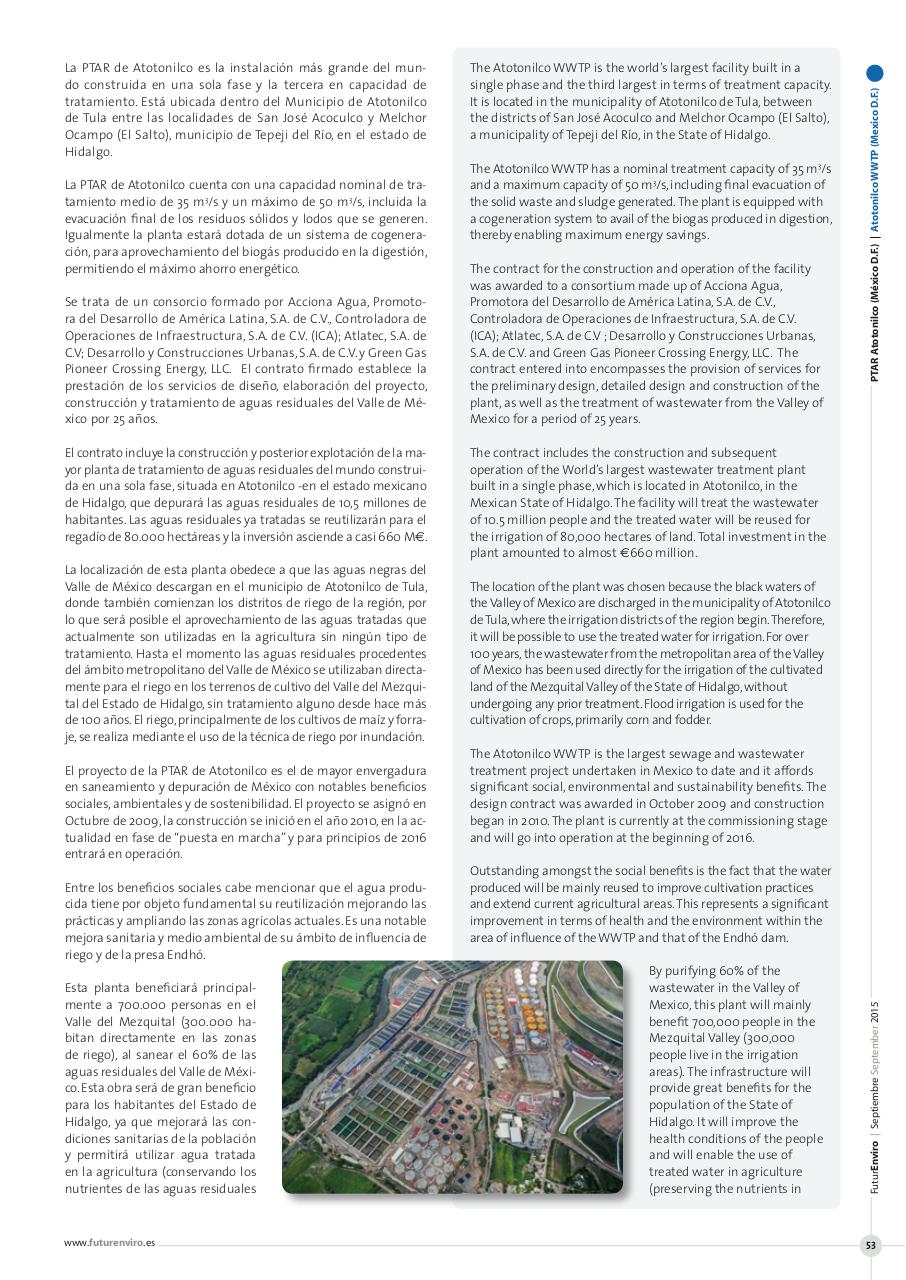
The Atotonilco WWTP is the world’s largest facility built in a
single phase and the third largest in terms of treatment capacity.
It is located in the municipality of Atotonilco de Tula, between
the districts of San José Acoculco and Melchor Ocampo (El Salto),
a municipality of Tepeji del Río, in the State of Hidalgo.
The contract includes the construction and subsequent
operation of the World’s largest wastewater treatment plant
built in a single phase, which is located in Atotonilco, in the
Mexican State of Hidalgo. The facility will treat the wastewater
of 10.5 million people and the treated water will be reused for
the irrigation of 80,000 hectares of land. Total investment in the
plant amounted to almost €660 million.
The location of the plant was chosen because the black waters of
the Valley of Mexico are discharged in the municipality of Atotonilco
de Tula, where the irrigation districts of the region begin. Therefore,
it will be possible to use the treated water for irrigation. For over
100 years, the wastewater from the metropolitan area of the Valley
of Mexico has been used directly for the irrigation of the cultivated
land of the Mezquital Valley of the State of Hidalgo, without
undergoing any prior treatment. Flood irrigation is used for the
cultivation of crops, primarily corn and fodder.
The Atotonilco WWTP is the largest sewage and wastewater
treatment project undertaken in Mexico to date and it affords
significant social, environmental and sustainability benefits. The
design contract was awarded in October 2009 and construction
began in 2010. The plant is currently at the commissioning stage
and will go into operation at the beginning of 2016.
Outstanding amongst the social benefits is the fact that the water
produced will be mainly reused to improve cultivation practices
and extend current agricultural areas. This represents a significant
improvement in terms of health and the environment within the
area of influence of the WWTP and that of the Endhó dam.
By purifying 60% of the
wastewater in the Valley of
Mexico, this plant will mainly
benefit 700,000 people in the
Mezquital Valley (300,000
people live in the irrigation
areas). The infrastructure will
provide great benefits for the
population of the State of
Hidalgo. It will improve the
health conditions of the people
and will enable the use of
treated water in agriculture
(preserving the nutrients in
FuturEnviro | Septiembre September 2015
La PTAR de Atotonilco es la instalación más grande del mundo construida en una sola fase y la tercera en capacidad de
tratamiento. Está ubicada dentro del Municipio de Atotonilco
de Tula entre las localidades de San José Acoculco y Melchor
Ocampo (El Salto), municipio de Tepeji del Río, en el estado de
Hidalgo.
53