
Some Notes on the History of the French Cuisine. Carlos Mirasierras.pdf
Vista previa de texto
Some Notes on the History of the French Cuisine. From the Middles Ages to late 20th century. Carlos Mirasierras
The 1960s brought about innovative ideas to the
French cuisine, and especially because of the
contribution made by Portuguese immigrants
who had arrived to the country fleeing the forced
drafting to the Colonial Wars that Portugal was
fighting in Africa. Many new dishes were
introduced, as well as new techniques. This
period was also marked by the appearance of
the “Nouvelle Cuisine”.
The term nouvelle cuisine has been used many
times in the history of French cuisine. In the
1740s, Menon first used the term, but the
cooking practices of Vincent La Chapelle and
François Marin were also regarded as modern. In
the 1960s, Henri Gault and Christian Millau
revived it to describe the cooking practices of
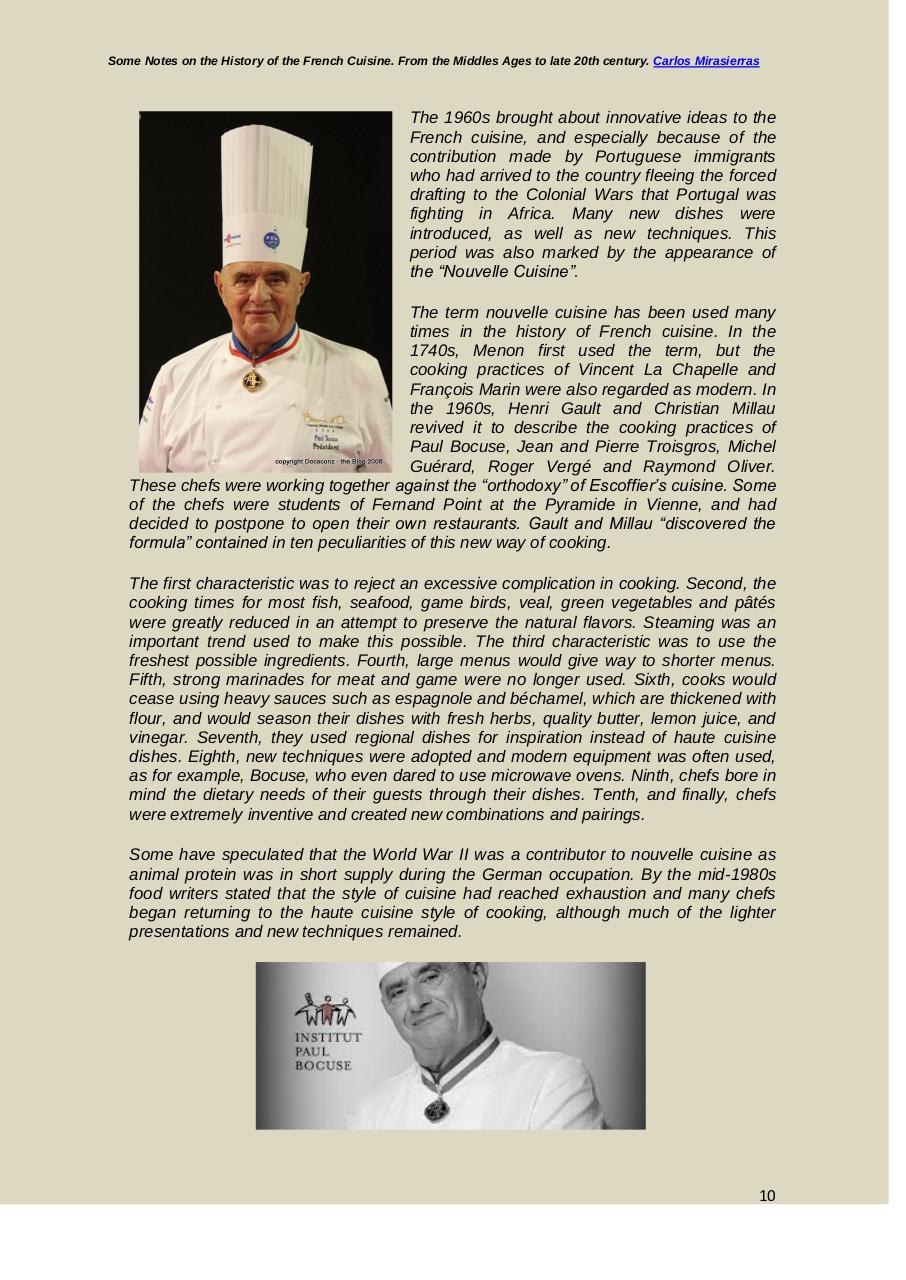
Paul Bocuse, Jean and Pierre Troisgros, Michel
Guérard, Roger Vergé and Raymond Oliver.
These chefs were working together against the “orthodoxy” of Escoffier’s cuisine. Some
of the chefs were students of Fernand Point at the Pyramide in Vienne, and had
decided to postpone to open their own restaurants. Gault and Millau “discovered the
formula” contained in ten peculiarities of this new way of cooking.
The first characteristic was to reject an excessive complication in cooking. Second, the
cooking times for most fish, seafood, game birds, veal, green vegetables and pâtés
were greatly reduced in an attempt to preserve the natural flavors. Steaming was an
important trend used to make this possible. The third characteristic was to use the
freshest possible ingredients. Fourth, large menus would give way to shorter menus.
Fifth, strong marinades for meat and game were no longer used. Sixth, cooks would
cease using heavy sauces such as espagnole and béchamel, which are thickened with
flour, and would season their dishes with fresh herbs, quality butter, lemon juice, and
vinegar. Seventh, they used regional dishes for inspiration instead of haute cuisine
dishes. Eighth, new techniques were adopted and modern equipment was often used,
as for example, Bocuse, who even dared to use microwave ovens. Ninth, chefs bore in
mind the dietary needs of their guests through their dishes. Tenth, and finally, chefs
were extremely inventive and created new combinations and pairings.
Some have speculated that the World War II was a contributor to nouvelle cuisine as
animal protein was in short supply during the German occupation. By the mid-1980s
food writers stated that the style of cuisine had reached exhaustion and many chefs
began returning to the haute cuisine style of cooking, although much of the lighter
presentations and new techniques remained.
10