
anexo4 OtmarGeiss.pdf
Vista previa de texto
Special Issue on COVID-19 Aerosol Drivers, Impacts and Mitigation (X)
ORIGINAL RESEARCH
https://doi.org/10.4209/aaqr.2020.07.0403
manufactured by a northern Italian company that converted its production from sportswear to
face masks during the pandemic. It was made of three layers: the internal and external layers
were primarily made of polyamide, and the interior filter was made out of polyester.
2.2 Instrumentation
Carbon dioxide concentrations were measured with a TSI 7545 IAQ Meter (TSI Incorporated,
Shoreview MN, USA) equipped with a low-drift dual-wavelength NDIR CO2 sensor. This instrument
has a declared measurement concentration range of 0–5000 ppm and an accuracy of ± 3.0% of
reading or ± 50 ppm (whichever is greater). Its resolution is 1 ppm. The instrument was calibrated
against a secondary carbon dioxide standard (470 ppm). All measurements were performed on
the same day the instrument was calibrated.
2.3 Experimental Setup
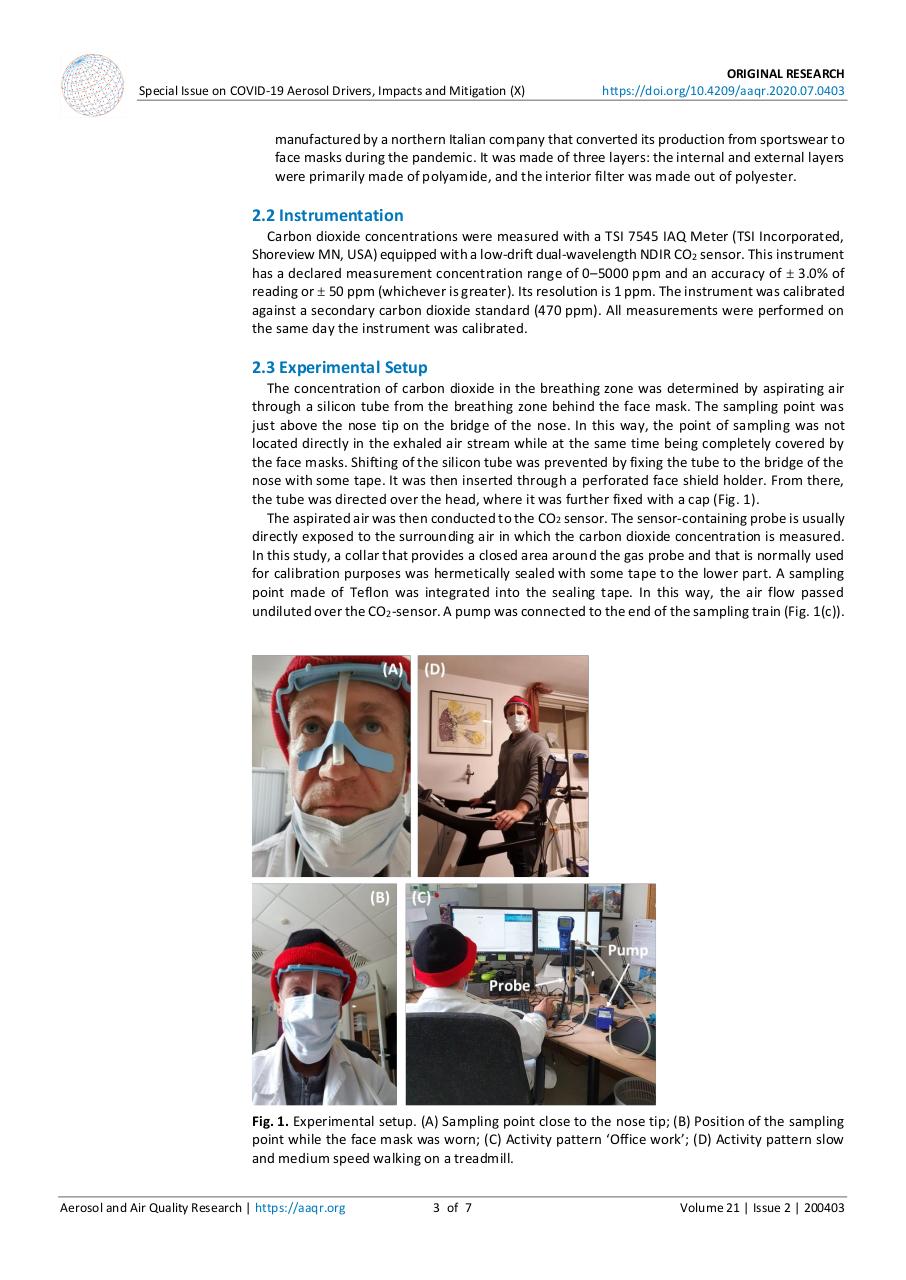
The concentration of carbon dioxide in the breathing zone was determined by aspirating air
through a silicon tube from the breathing zone behind the face mask. The sampling point was
just above the nose tip on the bridge of the nose. In this way, the point of sampling was not
located directly in the exhaled air stream while at the same time being completely covered by
the face masks. Shifting of the silicon tube was prevented by fixing the tube to the bridge of the
nose with some tape. It was then inserted through a perforated face shield holder. From there,
the tube was directed over the head, where it was further fixed with a cap (Fig. 1).
The aspirated air was then conducted to the CO2 sensor. The sensor-containing probe is usually
directly exposed to the surrounding air in which the carbon dioxide concentration is measured.
In this study, a collar that provides a closed area around the gas probe and that is normally used
for calibration purposes was hermetically sealed with some tape to the lower part. A sampling
point made of Teflon was integrated into the sealing tape. In this way, the air flow passed
undiluted over the CO2-sensor. A pump was connected to the end of the sampling train (Fig. 1(c)).
Fig. 1. Experimental setup. (A) Sampling point close to the nose tip; (B) Position of the sampling
point while the face mask was worn; (C) Activity pattern ‘Office work’; (D) Activity pattern slow
and medium speed walking on a treadmill.
Aerosol and Air Quality Research | https://aaqr.org
3 of 7
Volume 21 | Issue 2 | 200403