
tc3 97 61.pdf
Vista previa de texto
Mountaineering Equipment
CHOCK PICKS
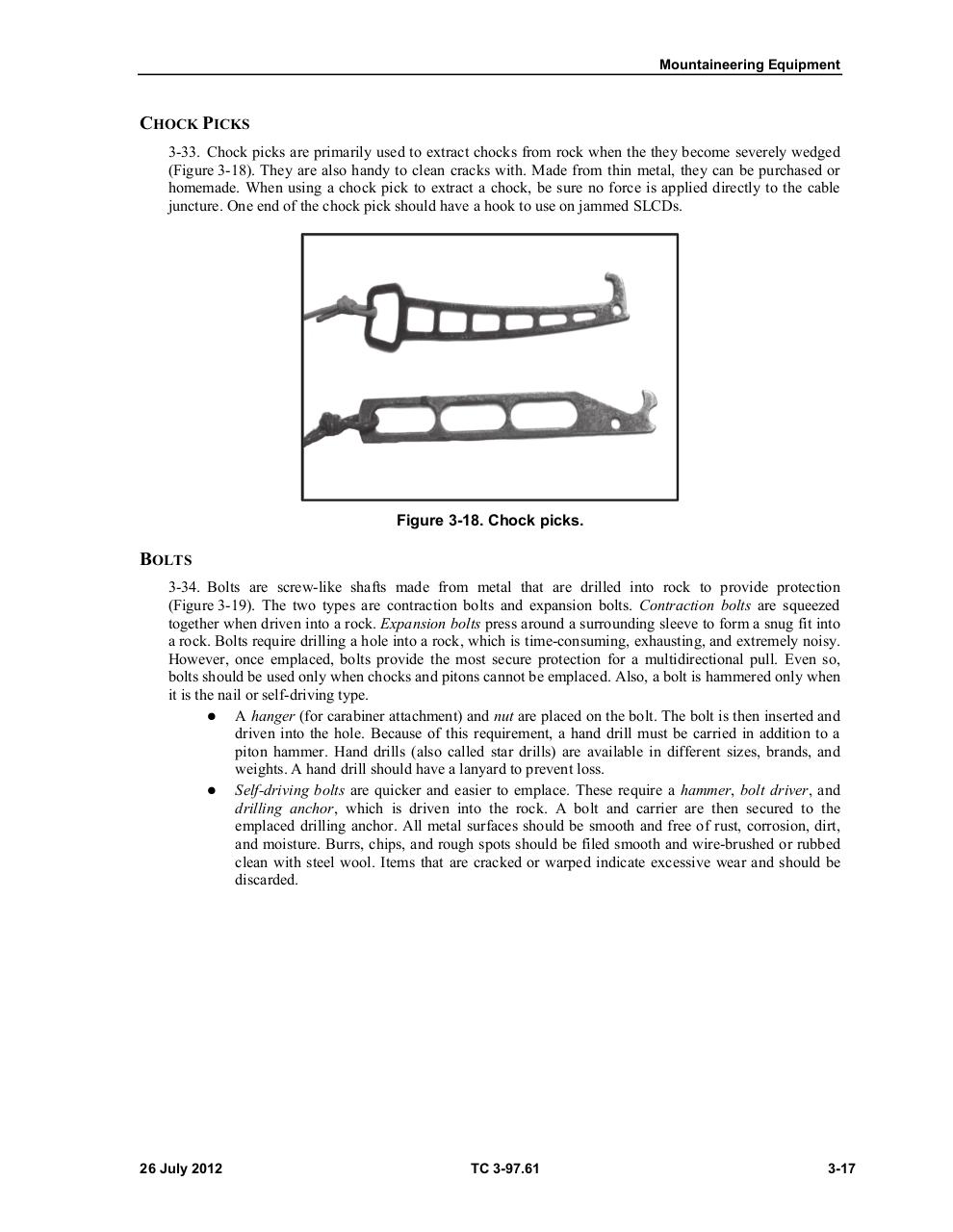
3-33. Chock picks are primarily used to extract chocks from rock when the they become severely wedged
(Figure 3-18). They are also handy to clean cracks with. Made from thin metal, they can be purchased or
homemade. When using a chock pick to extract a chock, be sure no force is applied directly to the cable
juncture. One end of the chock pick should have a hook to use on jammed SLCDs.
Figure 3-18. Chock picks.
BOLTS
3-34. Bolts are screw-like shafts made from metal that are drilled into rock to provide protection
(Figure 3-19). The two types are contraction bolts and expansion bolts. Contraction bolts are squeezed
together when driven into a rock. Expansion bolts press around a surrounding sleeve to form a snug fit into
a rock. Bolts require drilling a hole into a rock, which is time-consuming, exhausting, and extremely noisy.
However, once emplaced, bolts provide the most secure protection for a multidirectional pull. Even so,
bolts should be used only when chocks and pitons cannot be emplaced. Also, a bolt is hammered only when
it is the nail or self-driving type.
A hanger (for carabiner attachment) and nut are placed on the bolt. The bolt is then inserted and
driven into the hole. Because of this requirement, a hand drill must be carried in addition to a
piton hammer. Hand drills (also called star drills) are available in different sizes, brands, and
weights. A hand drill should have a lanyard to prevent loss.
Self-driving bolts are quicker and easier to emplace. These require a hammer, bolt driver, and
drilling anchor, which is driven into the rock. A bolt and carrier are then secured to the
emplaced drilling anchor. All metal surfaces should be smooth and free of rust, corrosion, dirt,
and moisture. Burrs, chips, and rough spots should be filed smooth and wire-brushed or rubbed
clean with steel wool. Items that are cracked or warped indicate excessive wear and should be
discarded.
26 July 2012
TC 3-97.61
3-17