
Efateà num.1.pdf
Vista previa de texto
pàgina 4
efateí l’entrevista
Karen Metcalfe
«Just like Bilbo Baggins in The Lord Of the Rings,
I believe I am very ready for yet another adventure.»
Redacció i correcció de Sara Fernández Carmona, Olga
Vert Bolaños i Oscar García Bragado
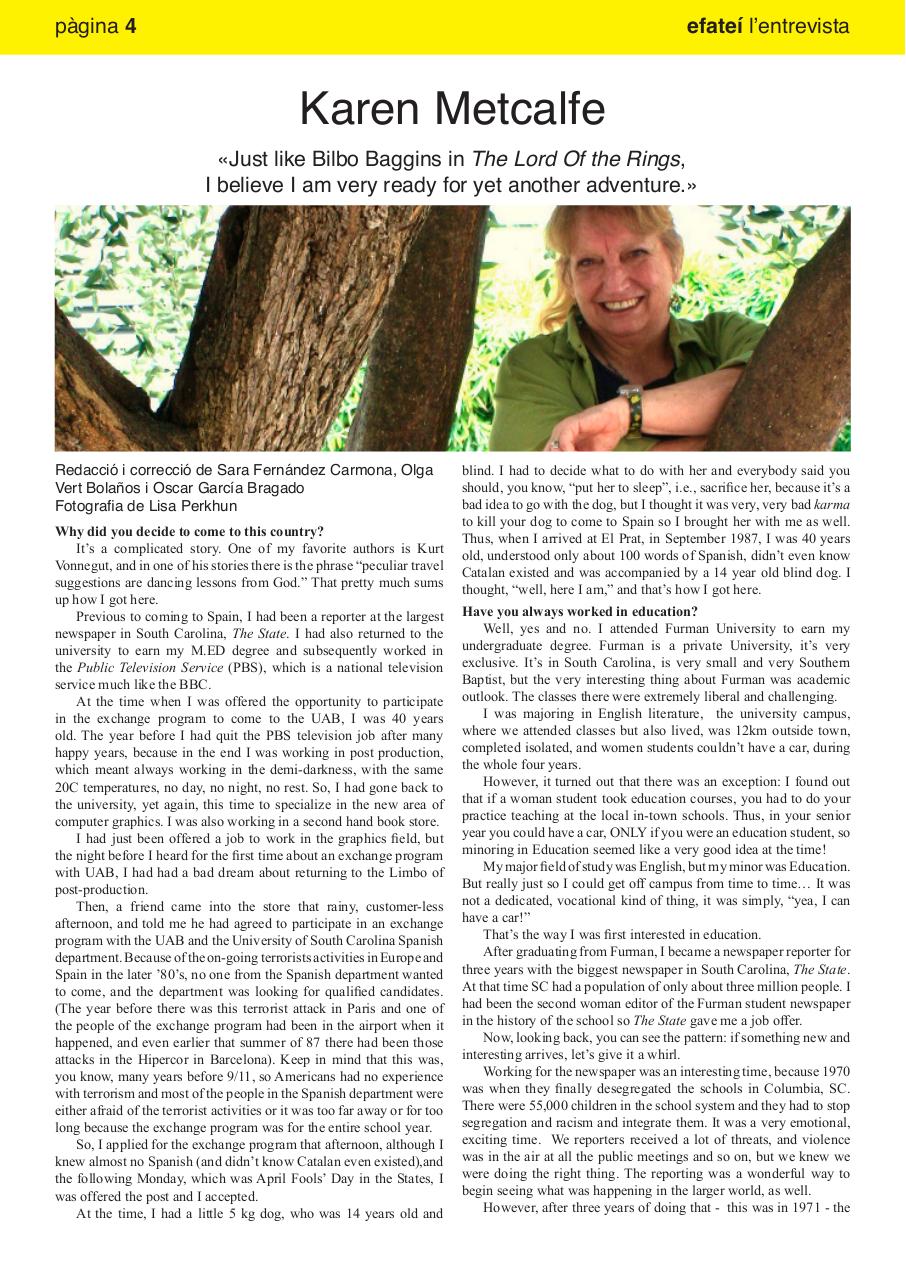
Fotografia de Lisa Perkhun
Why did you decide to come to this country?
It’s a complicated story. One of my favorite authors is Kurt
Vonnegut, and in one of his stories there is the phrase “peculiar travel
suggestions are dancing lessons from God.” That pretty much sums
up how I got here.
Previous to coming to Spain, I had been a reporter at the largest
newspaper in South Carolina, The State. I had also returned to the
university to earn my M.ED degree and subsequently worked in
the Public Television Service (PBS), which is a national television
service much like the BBC.
At the time when I was offered the opportunity to participate
in the exchange program to come to the UAB, I was 40 years
old. The year before I had quit the PBS television job after many
happy years, because in the end I was working in post production,
which meant always working in the demi-darkness, with the same
20C temperatures, no day, no night, no rest. So, I had gone back to
the university, yet again, this time to specialize in the new area of
computer graphics. I was also working in a second hand book store.
I had just been offered a job to work in the graphics field, but
the night before I heard for the first time about an exchange program
with UAB, I had had a bad dream about returning to the Limbo of
post-production.
Then, a friend came into the store that rainy, customer-less
afternoon, and told me he had agreed to participate in an exchange
program with the UAB and the University of South Carolina Spanish
department. Because of the on-going terrorists activities in Europe and
Spain in the later ’80’s, no one from the Spanish department wanted
to come, and the department was looking for qualified candidates.
(The year before there was this terrorist attack in Paris and one of
the people of the exchange program had been in the airport when it
happened, and even earlier that summer of 87 there had been those
attacks in the Hipercor in Barcelona). Keep in mind that this was,
you know, many years before 9/11, so Americans had no experience
with terrorism and most of the people in the Spanish department were
either afraid of the terrorist activities or it was too far away or for too
long because the exchange program was for the entire school year.
So, I applied for the exchange program that afternoon, although I
knew almost no Spanish (and didn’t know Catalan even existed),and
the following Monday, which was April Fools’ Day in the States, I
was offered the post and I accepted.
At the time, I had a little 5 kg dog, who was 14 years old and
blind. I had to decide what to do with her and everybody said you
should, you know, “put her to sleep”, i.e., sacrifice her, because it’s a
bad idea to go with the dog, but I thought it was very, very bad karma
to kill your dog to come to Spain so I brought her with me as well.
Thus, when I arrived at El Prat, in September 1987, I was 40 years
old, understood only about 100 words of Spanish, didn’t even know
Catalan existed and was accompanied by a 14 year old blind dog. I
thought, “well, here I am,” and that’s how I got here.
Have you always worked in education?
Well, yes and no. I attended Furman University to earn my
undergraduate degree. Furman is a private University, it’s very
exclusive. It’s in South Carolina, is very small and very Southern
Baptist, but the very interesting thing about Furman was academic
outlook. The classes there were extremely liberal and challenging.
I was majoring in English literature, the university campus,
where we attended classes but also lived, was 12km outside town,
completed isolated, and women students couldn’t have a car, during
the whole four years.
However, it turned out that there was an exception: I found out
that if a woman student took education courses, you had to do your
practice teaching at the local in-town schools. Thus, in your senior
year you could have a car, ONLY if you were an education student, so
minoring in Education seemed like a very good idea at the time!
My major field of study was English, but my minor was Education.
But really just so I could get off campus from time to time… It was
not a dedicated, vocational kind of thing, it was simply, “yea, I can
have a car!”
That’s the way I was first interested in education.
After graduating from Furman, I became a newspaper reporter for
three years with the biggest newspaper in South Carolina, The State.
At that time SC had a population of only about three million people. I
had been the second woman editor of the Furman student newspaper
in the history of the school so The State gave me a job offer.
Now, looking back, you can see the pattern: if something new and
interesting arrives, let’s give it a whirl.
Working for the newspaper was an interesting time, because 1970
was when they finally desegregated the schools in Columbia, SC.
There were 55,000 children in the school system and they had to stop
segregation and racism and integrate them. It was a very emotional,
exciting time. We reporters received a lot of threats, and violence
was in the air at all the public meetings and so on, but we knew we
were doing the right thing. The reporting was a wonderful way to
begin seeing what was happening in the larger world, as well.
However, after three years of doing that - this was in 1971 - the