
Digital citizen empowerment a sytematic literature review fusionado.pdf
Vista previa de texto
INFORMATION TECHNOLOGY FOR DEVELOPMENT
5
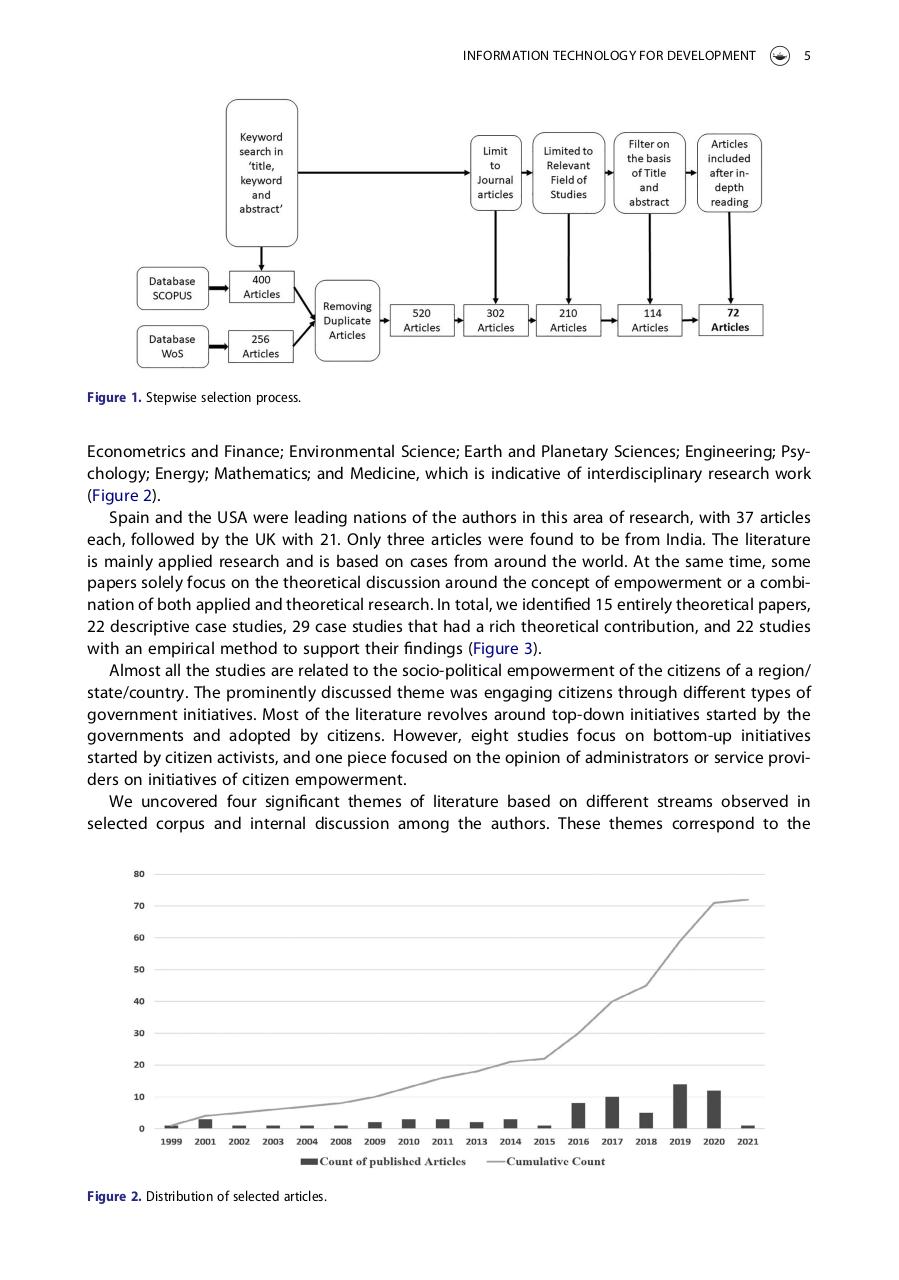
Figure 1. Stepwise selection process.
Econometrics and Finance; Environmental Science; Earth and Planetary Sciences; Engineering; Psychology; Energy; Mathematics; and Medicine, which is indicative of interdisciplinary research work
(Figure 2).
Spain and the USA were leading nations of the authors in this area of research, with 37 articles
each, followed by the UK with 21. Only three articles were found to be from India. The literature
is mainly applied research and is based on cases from around the world. At the same time, some
papers solely focus on the theoretical discussion around the concept of empowerment or a combination of both applied and theoretical research. In total, we identified 15 entirely theoretical papers,
22 descriptive case studies, 29 case studies that had a rich theoretical contribution, and 22 studies
with an empirical method to support their findings (Figure 3).
Almost all the studies are related to the socio-political empowerment of the citizens of a region/
state/country. The prominently discussed theme was engaging citizens through different types of
government initiatives. Most of the literature revolves around top-down initiatives started by the
governments and adopted by citizens. However, eight studies focus on bottom-up initiatives
started by citizen activists, and one piece focused on the opinion of administrators or service providers on initiatives of citizen empowerment.
We uncovered four significant themes of literature based on different streams observed in
selected corpus and internal discussion among the authors. These themes correspond to the
Figure 2. Distribution of selected articles.