
Digital citizen empowerment a sytematic literature review fusionado.pdf
Vista previa de texto
Notes: Green cells indicate that the case confirms the literature; orange cells indicate that the case shows a certain factor was not found in the case; yellow
cells indicate new factors.
6. Discussion
This study focuses on citizen-led engagement in which citizens fully independently organized
themselves, with low or nonexistent involvement from the government, in using OGD to solve a
societal problem. Our case shows highly initiatory citizens who innovate with the opened election data
and provide a more effective and transparent service in tabulating the votes to society. Reflecting on
the level of government involvement with the end-users of open data (Sieber and Johnson, 2015), this
study represents the government as a platform model in which the government merely supplies data
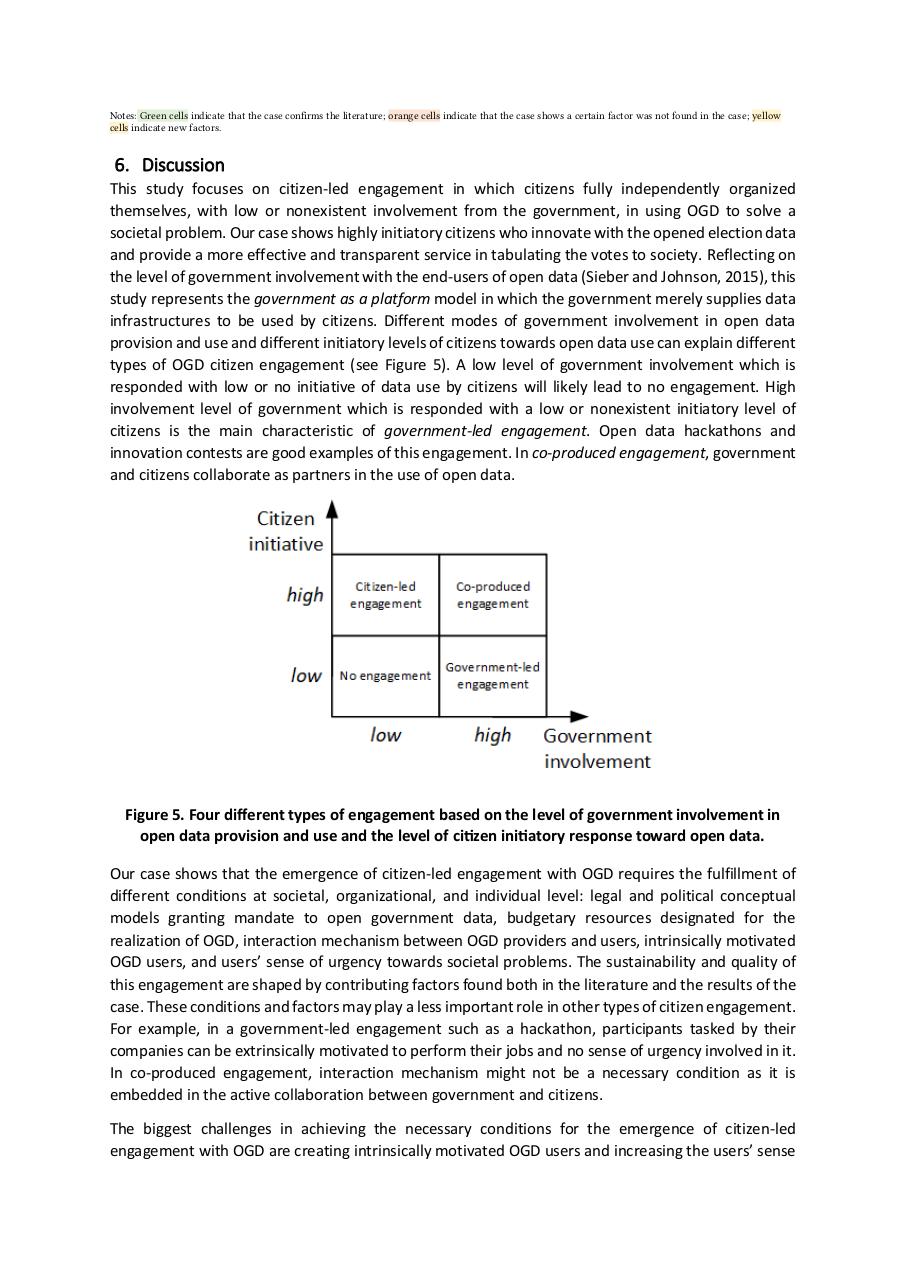
infrastructures to be used by citizens. Different modes of government involvement in open data
provision and use and different initiatory levels of citizens towards open data use can explain different
types of OGD citizen engagement (see Figure 5). A low level of government involvement which is
responded with low or no initiative of data use by citizens will likely lead to no engagement. High
involvement level of government which is responded with a low or nonexistent initiatory level of
citizens is the main characteristic of government-led engagement. Open data hackathons and
innovation contests are good examples of this engagement. In co-produced engagement, government
and citizens collaborate as partners in the use of open data.
Figure 5. Four different types of engagement based on the level of government involvement in
open data provision and use and the level of citizen initiatory response toward open data.
Our case shows that the emergence of citizen-led engagement with OGD requires the fulfillment of
different conditions at societal, organizational, and individual level: legal and political conceptual
models granting mandate to open government data, budgetary resources designated for the
realization of OGD, interaction mechanism between OGD providers and users, intrinsically motivated
OGD users, and users’ sense of urgency towards societal problems. The sustainability and quality of
this engagement are shaped by contributing factors found both in the literature and the results of the
case. These conditions and factors may play a less important role in other types of citizen engagement.
For example, in a government-led engagement such as a hackathon, participants tasked by their
companies can be extrinsically motivated to perform their jobs and no sense of urgency involved in it.
In co-produced engagement, interaction mechanism might not be a necessary condition as it is
embedded in the active collaboration between government and citizens.
The biggest challenges in achieving the necessary conditions for the emergence of citizen-led
engagement with OGD are creating intrinsically motivated OGD users and increasing the users’ sense