
Digital citizen empowerment a sytematic literature review fusionado.pdf
Vista previa de texto
The variety of capabilities and skills possessed by volunteers was identified as one of the contributing
factors to the citizen-led engagement with OGD. Among volunteers were programmers, web security
specialists, data analysts, designers, social media specialists, journalists to public relations. The
diversity helped create not only reliable and secure platforms but also social media communication of
Kawal Pemilu for seeking public supports and reaching media coverage.
The intensive use of social media platforms was found to contribute to the citizen-led engagement
with OGD. For example, Facebook was used for recruiting volunteers and managing the progress of
digitization efforts, and Twitter for promoting the initiative, publishing the current election results
from the digitization and increasing the public awareness. These platforms provide the environment
needed for a citizen-led engagement, direct access to a swarm of citizens (Brajawidagda and Chatfield,
2014). The founder of Kawal Pemilu acknowledge the roles of social media as an enabler to his
initiative:
“We created a Facebook page, published all [the results], a Twitter account. We have a team
that focuses on managing social media [account]. So, in our social media [accounts], we are
doing a lot of posts, mentioning various kinds of important figures and so on, so [people]
starting to keep up, people know, people are starting to make them viral too. “
5.4 Overview of case study findings
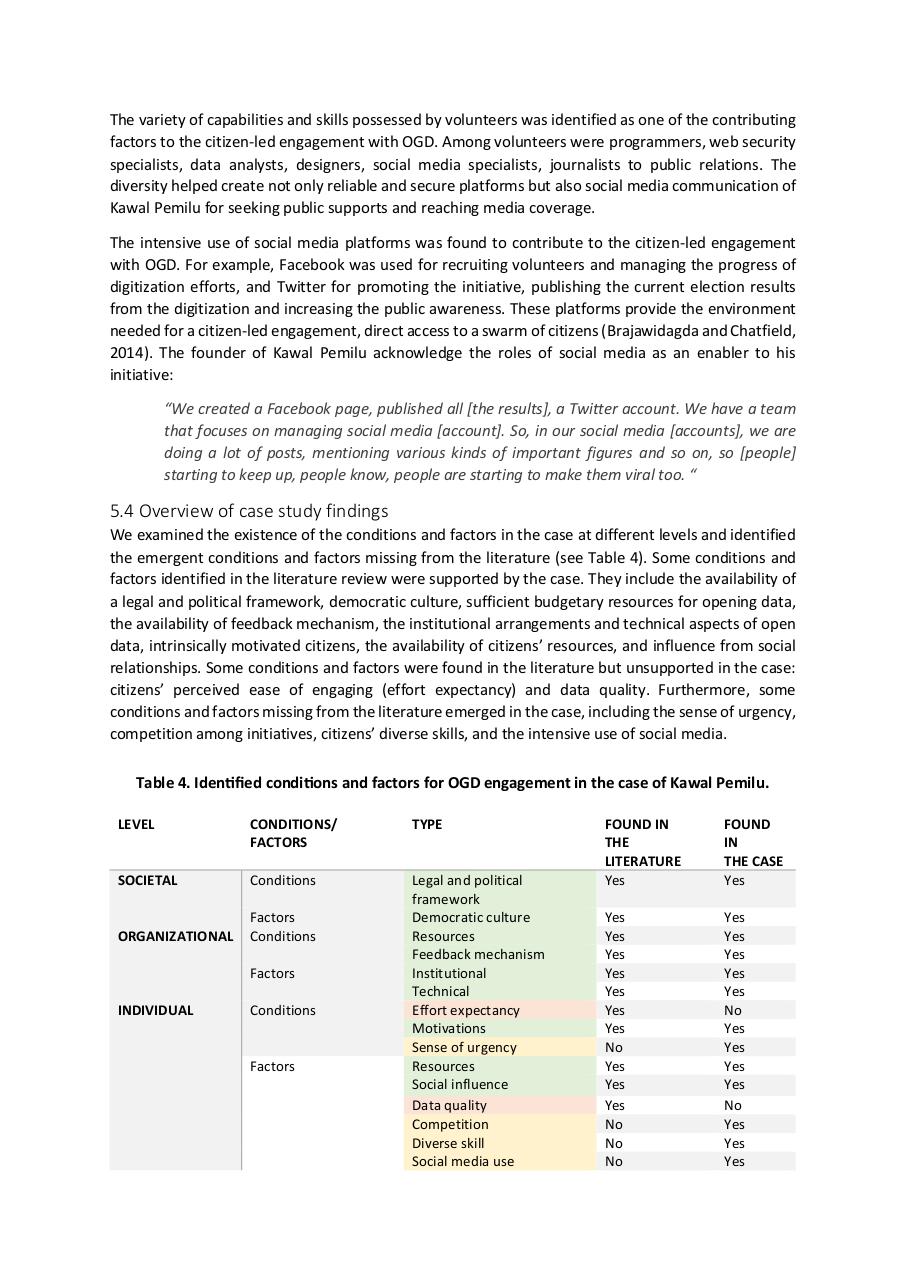
We examined the existence of the conditions and factors in the case at different levels and identified
the emergent conditions and factors missing from the literature (see Table 4). Some conditions and
factors identified in the literature review were supported by the case. They include the availability of
a legal and political framework, democratic culture, sufficient budgetary resources for opening data,
the availability of feedback mechanism, the institutional arrangements and technical aspects of open
data, intrinsically motivated citizens, the availability of citizens’ resources, and influence from social
relationships. Some conditions and factors were found in the literature but unsupported in the case:
citizens’ perceived ease of engaging (effort expectancy) and data quality. Furthermore, some
conditions and factors missing from the literature emerged in the case, including the sense of urgency,
competition among initiatives, citizens’ diverse skills, and the intensive use of social media.
Table 4. Identified conditions and factors for OGD engagement in the case of Kawal Pemilu.
LEVEL
CONDITIONS/
FACTORS
TYPE
SOCIETAL
Conditions
ORGANIZATIONAL
Factors
Conditions
Legal and political
framework
Democratic culture
Resources
Feedback mechanism
Institutional
Technical
Effort expectancy
Motivations
Sense of urgency
Resources
Social influence
Data quality
Competition
Diverse skill
Social media use
Factors
INDIVIDUAL
Conditions
Factors
FOUND IN
THE
LITERATURE
Yes
FOUND
IN
THE CASE
Yes
Yes
Yes
Yes
Yes
Yes
Yes
Yes
No
Yes
Yes
Yes
No
No
No
Yes
Yes
Yes
Yes
Yes
No
Yes
Yes
Yes
Yes
No
Yes
Yes
Yes