
Digital citizen empowerment a sytematic literature review fusionado.pdf
Vista previa de texto
JeDEM 6(1): 69-79, 2014
73
The attribute mapping step incorporates disambiguation of the attributes proceeds through
linking them to the right concepts in the knowledge base (KB). We identify two kinds of mapping,
direct mapping and indirect mapping. Finding the name of the attribute attached to the intended
concept in the KB and linking to it is called direct mapping. Not always a direct mapping is present
for an attribute. Finding the right sense of a term through its synonyms is called indirect mapping.
Note that synonyms can be suggested by user or retrieved from a KB.
The data modelling step leads to understanding an entity type from the attributes extracted in the
previous step and finding it (if exists) or a suitable parent (if created newly) in the already existing
entity type lattice, a lightweight ontology (see (Giunchiglia, 2009)) formed with the concepts of the
entity types. In the entity type development step, we produce a specification of an entity type
defining all possible attributes, their data types (e.g. string, float) and meta attributes such as
permanence (e.g. temporary, permanent), presence (e.g. mandatory, optional) and category (e.g.
temporal, physical).
While producing entities of a given entity type, mandatory and optional attributes are filled in with
data, which are semantified and disambiguated wherever applicable. In fact data for an entity can
come from multiple resources. Through semantification, we facilitate the integration of loosely
coupled data. In the case of unavailability of a mandatory attribute in the possible resources, we
signal it to the data provider as pro-sumers, see (Charalabidis, 2014) and do not allow the creation
of the corresponding entity unless all necessary data are present. This is how we can improve the
vertical completeness.
4. Open Data Rise
10
Open Data Rise (ODR) is an open source web application for data curation of OGD. It allows to
easily fix errors in source data and also to enrich names by linking them to their precise meaning in
a process called semantification. The framework employs the entity-centric model (Giunchiglia,
11
2012) and extends OpenRefine , an open source tool for cleansing messy data. The
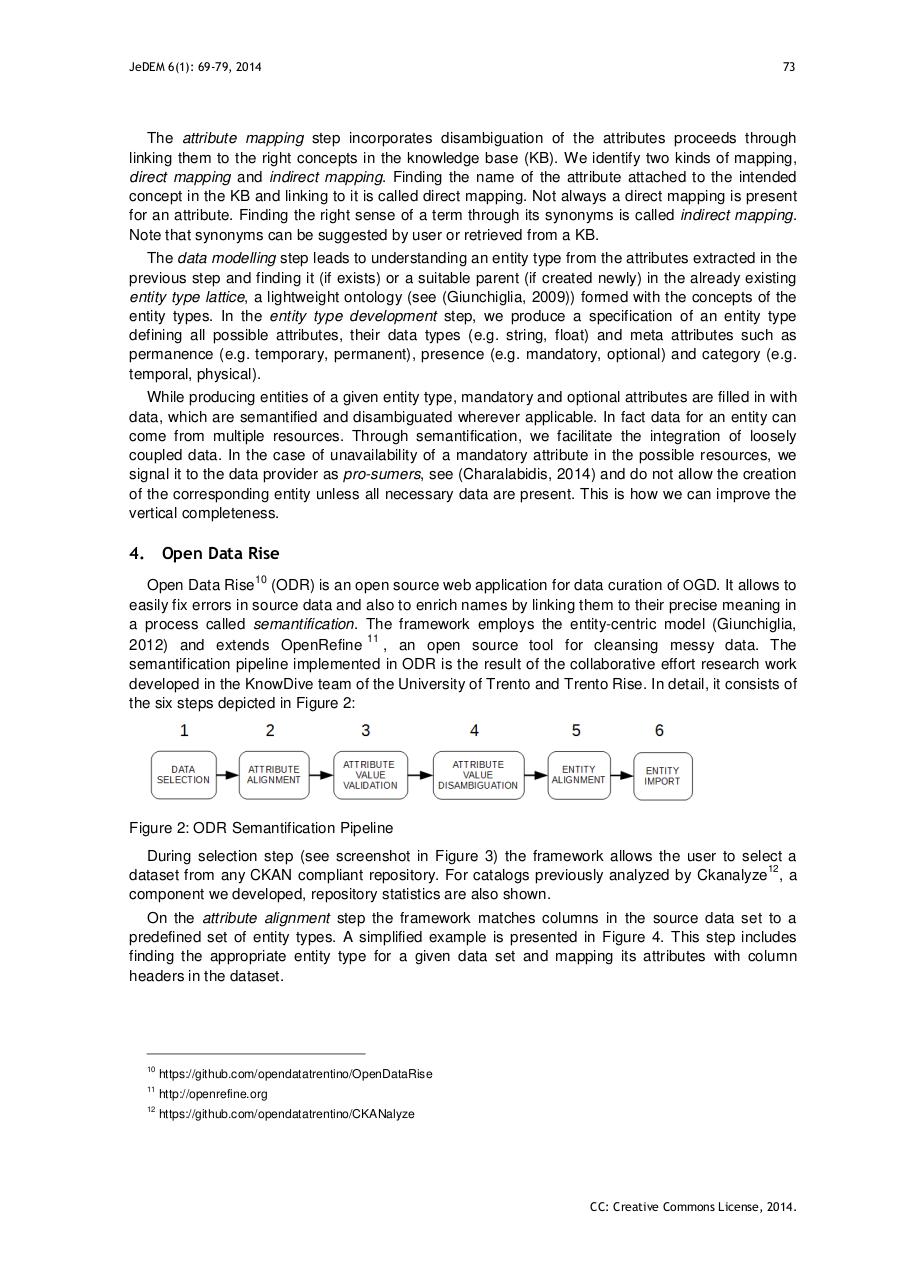
semantification pipeline implemented in ODR is the result of the collaborative effort research work
developed in the KnowDive team of the University of Trento and Trento Rise. In detail, it consists of
the six steps depicted in Figure 2:
Figure 2: ODR Semantification Pipeline
During selection step (see screenshot in Figure 3) the framework allows the user to select a
12
dataset from any CKAN compliant repository. For catalogs previously analyzed by Ckanalyze , a
component we developed, repository statistics are also shown.
On the attribute alignment step the framework matches columns in the source data set to a
predefined set of entity types. A simplified example is presented in Figure 4. This step includes
finding the appropriate entity type for a given data set and mapping its attributes with column
headers in the dataset.
10
https://github.com/opendatatrentino/OpenDataRise
11
http://openrefine.org
12
https://github.com/opendatatrentino/CKANalyze
CC: Creative Commons License, 2014.