
Digital citizen empowerment a sytematic literature review fusionado.pdf
Vista previa de texto
72
Ivan Bedini, Feroz Farazi, David Leoni, Juan Pane, Ivan Tankoyeu, Stefano Leucci
approach of involving directly the people working in the PA with the creation of a concrete data
culture is a successful approach.
3. Entity Type Generation
This Section depicts an entity centric approach for modelling OGD. It describes the generation of
entity types according to the data published in government data catalogues. An entity type (also
called as eType) is the class of an entity that has the right amount of attributes and relations for
forming the foundation of creating entities with their non-trivial details intended for an application
(Giunchiglia, 2012; Maltese, 2012; Farazi, 2008). Some examples of entity types are person,
location, organization and facility. An entity is a real world physical or abstract or digital thing that
can be referred with a name (Giunchiglia, 2012). For example, Dante Alighieri (person), Trento
(location), University of Trento (organization) and Trento Railway Station (facility) are entities.
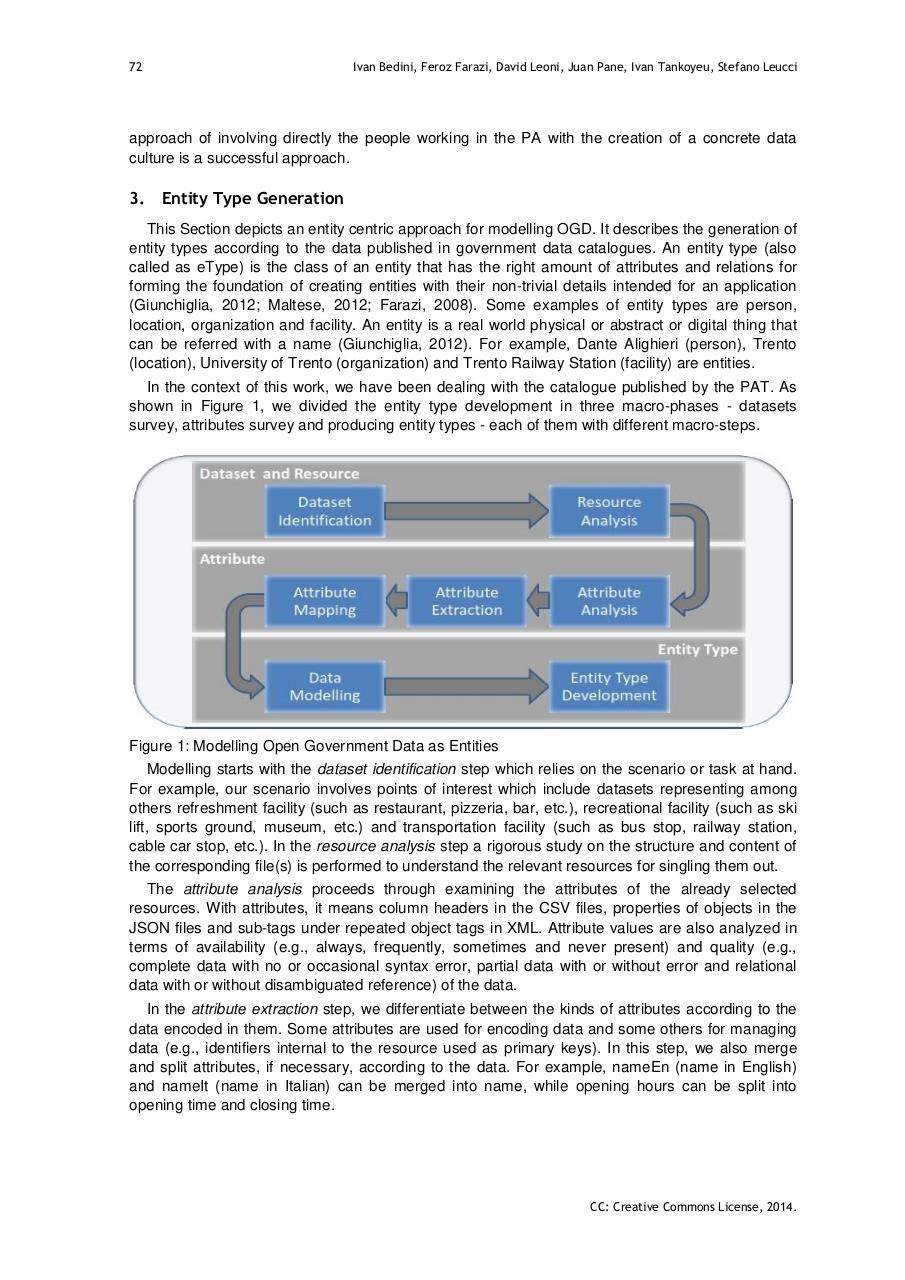
In the context of this work, we have been dealing with the catalogue published by the PAT. As
shown in Figure 1, we divided the entity type development in three macro-phases - datasets
survey, attributes survey and producing entity types - each of them with different macro-steps.
Figure 1: Modelling Open Government Data as Entities
Modelling starts with the dataset identification step which relies on the scenario or task at hand.
For example, our scenario involves points of interest which include datasets representing among
others refreshment facility (such as restaurant, pizzeria, bar, etc.), recreational facility (such as ski
lift, sports ground, museum, etc.) and transportation facility (such as bus stop, railway station,
cable car stop, etc.). In the resource analysis step a rigorous study on the structure and content of
the corresponding file(s) is performed to understand the relevant resources for singling them out.
The attribute analysis proceeds through examining the attributes of the already selected
resources. With attributes, it means column headers in the CSV files, properties of objects in the
JSON files and sub-tags under repeated object tags in XML. Attribute values are also analyzed in
terms of availability (e.g., always, frequently, sometimes and never present) and quality (e.g.,
complete data with no or occasional syntax error, partial data with or without error and relational
data with or without disambiguated reference) of the data.
In the attribute extraction step, we differentiate between the kinds of attributes according to the
data encoded in them. Some attributes are used for encoding data and some others for managing
data (e.g., identifiers internal to the resource used as primary keys). In this step, we also merge
and split attributes, if necessary, according to the data. For example, nameEn (name in English)
and nameIt (name in Italian) can be merged into name, while opening hours can be split into
opening time and closing time.
CC: Creative Commons License, 2014.