
Digital citizen empowerment a sytematic literature review fusionado.pdf
Vista previa de texto
INFORMATION TECHNOLOGY FOR DEVELOPMENT
15
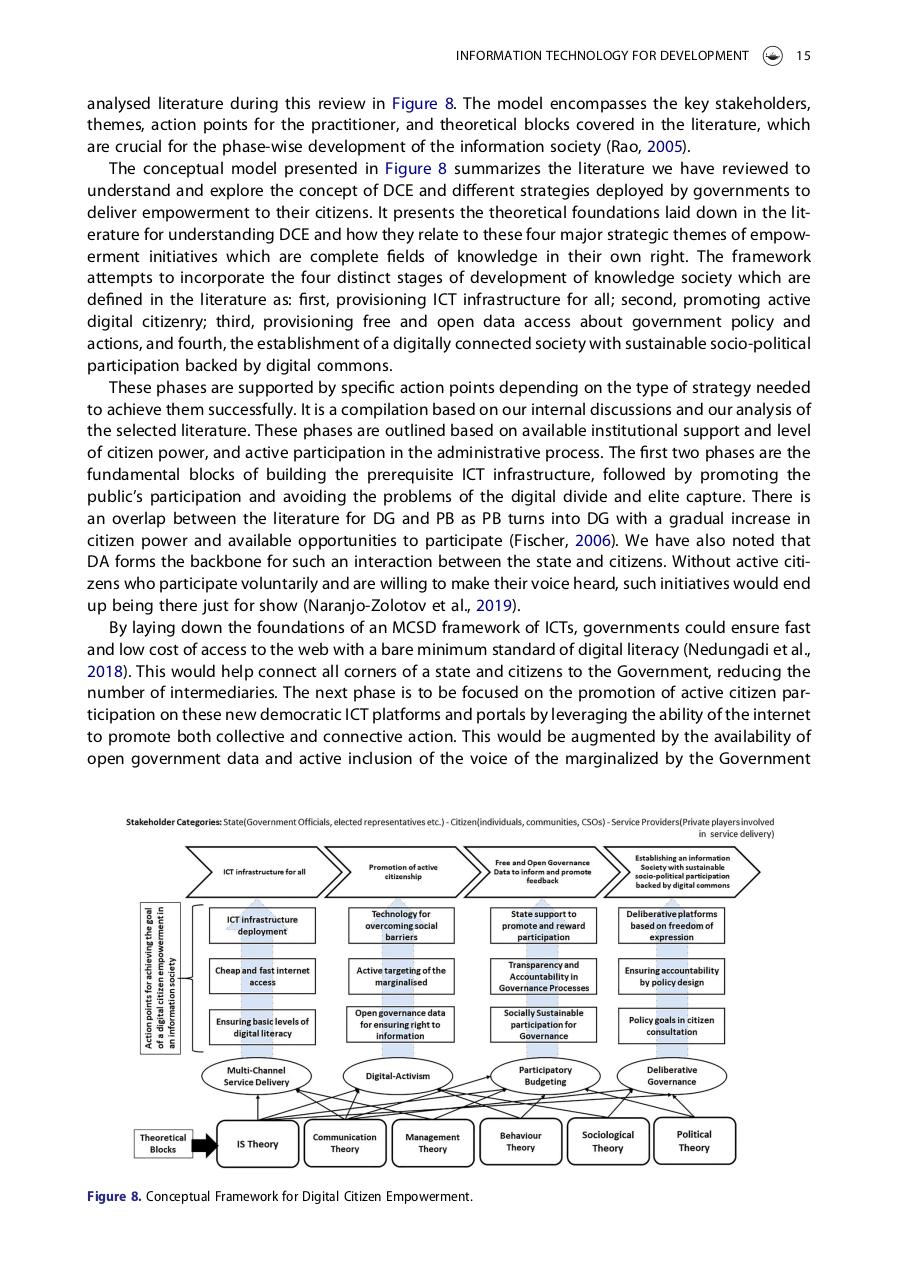
analysed literature during this review in Figure 8. The model encompasses the key stakeholders,
themes, action points for the practitioner, and theoretical blocks covered in the literature, which
are crucial for the phase-wise development of the information society (Rao, 2005).
The conceptual model presented in Figure 8 summarizes the literature we have reviewed to
understand and explore the concept of DCE and different strategies deployed by governments to
deliver empowerment to their citizens. It presents the theoretical foundations laid down in the literature for understanding DCE and how they relate to these four major strategic themes of empowerment initiatives which are complete fields of knowledge in their own right. The framework
attempts to incorporate the four distinct stages of development of knowledge society which are
defined in the literature as: first, provisioning ICT infrastructure for all; second, promoting active
digital citizenry; third, provisioning free and open data access about government policy and
actions, and fourth, the establishment of a digitally connected society with sustainable socio-political
participation backed by digital commons.
These phases are supported by specific action points depending on the type of strategy needed
to achieve them successfully. It is a compilation based on our internal discussions and our analysis of
the selected literature. These phases are outlined based on available institutional support and level
of citizen power, and active participation in the administrative process. The first two phases are the
fundamental blocks of building the prerequisite ICT infrastructure, followed by promoting the
public’s participation and avoiding the problems of the digital divide and elite capture. There is
an overlap between the literature for DG and PB as PB turns into DG with a gradual increase in
citizen power and available opportunities to participate (Fischer, 2006). We have also noted that
DA forms the backbone for such an interaction between the state and citizens. Without active citizens who participate voluntarily and are willing to make their voice heard, such initiatives would end
up being there just for show (Naranjo-Zolotov et al., 2019).
By laying down the foundations of an MCSD framework of ICTs, governments could ensure fast
and low cost of access to the web with a bare minimum standard of digital literacy (Nedungadi et al.,
2018). This would help connect all corners of a state and citizens to the Government, reducing the
number of intermediaries. The next phase is to be focused on the promotion of active citizen participation on these new democratic ICT platforms and portals by leveraging the ability of the internet
to promote both collective and connective action. This would be augmented by the availability of
open government data and active inclusion of the voice of the marginalized by the Government
Figure 8. Conceptual Framework for Digital Citizen Empowerment.