
Libro de Oro Marca Peru 2012.pdf
Vista previa de texto
35
ser parte de la promoción gastronómica de nuestro país.
Todos los que participamos sabemos lo importante que
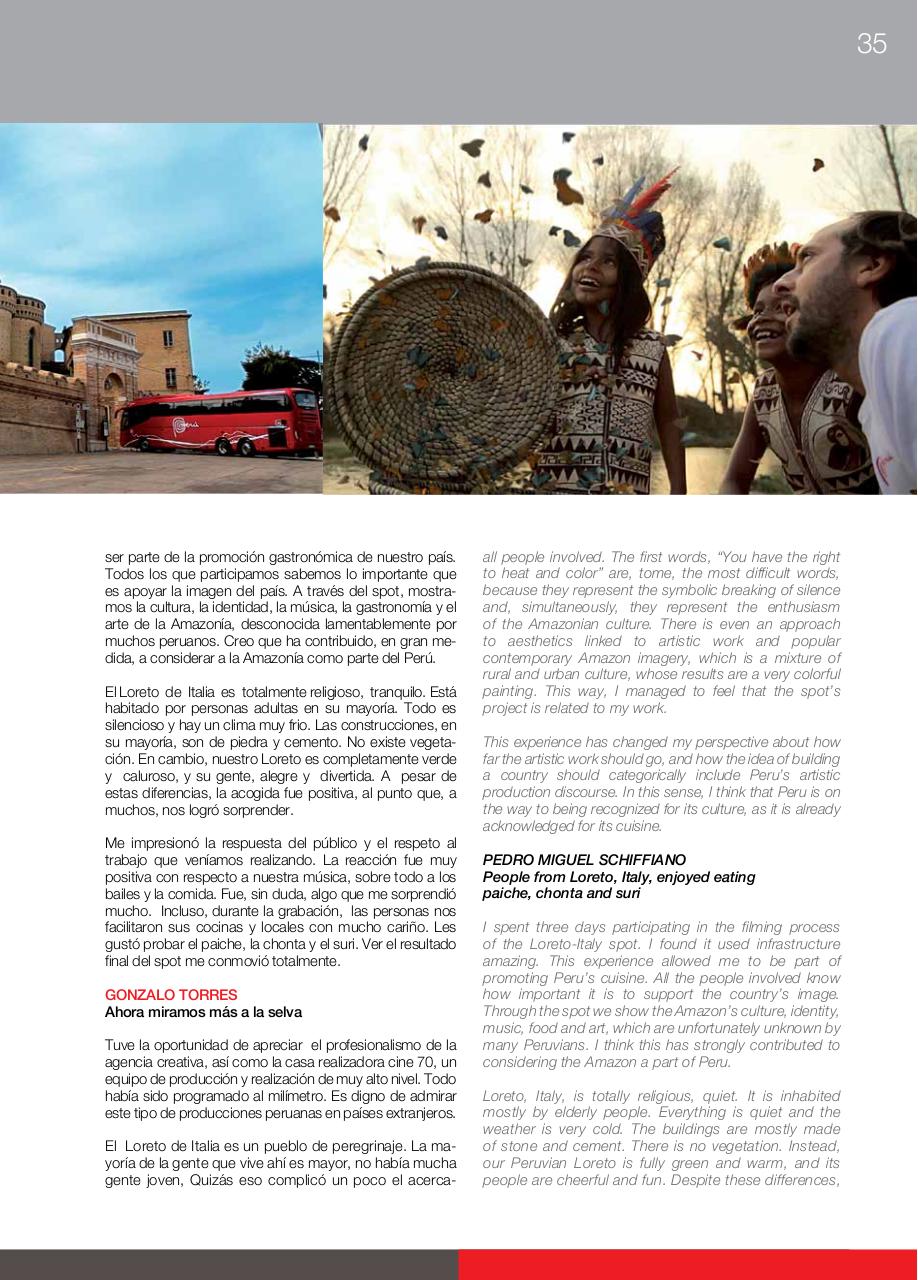
es apoyar la imagen del país. A través del spot, mostramos la cultura, la identidad, la música, la gastronomía y el
arte de la Amazonía, desconocida lamentablemente por
muchos peruanos. Creo que ha contribuido, en gran medida, a considerar a la Amazonía como parte del Perú.
El Loreto de Italia es totalmente religioso, tranquilo. Está
habitado por personas adultas en su mayoría. Todo es
silencioso y hay un clima muy frio. Las construcciones, en
su mayoría, son de piedra y cemento. No existe vegetación. En cambio, nuestro Loreto es completamente verde
y caluroso, y su gente, alegre y divertida. A pesar de
estas diferencias, la acogida fue positiva, al punto que, a
muchos, nos logró sorprender.
Me impresionó la respuesta del público y el respeto al
trabajo que veníamos realizando. La reacción fue muy
positiva con respecto a nuestra música, sobre todo a los
bailes y la comida. Fue, sin duda, algo que me sorprendió
mucho. Incluso, durante la grabación, las personas nos
facilitaron sus cocinas y locales con mucho cariño. Les
gustó probar el paiche, la chonta y el suri. Ver el resultado
final del spot me conmovió totalmente.
Gonzalo Torres
Ahora miramos más a la selva
Tuve la oportunidad de apreciar el profesionalismo de la
agencia creativa, así como la casa realizadora cine 70, un
equipo de producción y realización de muy alto nivel. Todo
había sido programado al milímetro. Es digno de admirar
este tipo de producciones peruanas en países extranjeros.
El Loreto de Italia es un pueblo de peregrinaje. La mayoría de la gente que vive ahí es mayor, no había mucha
gente joven, Quizás eso complicó un poco el acerca-
all people involved. The first words, “You have the right
to heat and color” are, tome, the most difficult words,
because they represent the symbolic breaking of silence
and, simultaneously, they represent the enthusiasm
of the Amazonian culture. There is even an approach
to aesthetics linked to artistic work and popular
contemporary Amazon imagery, which is a mixture of
rural and urban culture, whose results are a very colorful
painting. This way, I managed to feel that the spot’s
project is related to my work.
This experience has changed my perspective about how
far the artistic work should go, and how the idea of building
a country should categorically include Peru’s artistic
production discourse. In this sense, I think that Peru is on
the way to being recognized for its culture, as it is already
acknowledged for its cuisine.
Pedro Miguel Schiffiano
People from Loreto, Italy, enjoyed eating
paiche, chonta and suri
I spent three days participating in the filming process
of the Loreto-Italy spot. I found it used infrastructure
amazing. This experience allowed me to be part of
promoting Peru’s cuisine. All the people involved know
how important it is to support the country’s image.
Through the spot we show the Amazon’s culture, identity,
music, food and art, which are unfortunately unknown by
many Peruvians. I think this has strongly contributed to
considering the Amazon a part of Peru.
Loreto, Italy, is totally religious, quiet. It is inhabited
mostly by elderly people. Everything is quiet and the
weather is very cold. The buildings are mostly made
of stone and cement. There is no vegetation. Instead,
our Peruvian Loreto is fully green and warm, and its
people are cheerful and fun. Despite these differences,