
tc3 97 61.pdf
Vista previa de texto
Mountain Living
SECTION II. ACCLIMATIZATION AND CONDITIONING
2-35. Terrestrial altitude can be classified into five categories. Low altitude is sea level to 5,000 feet. Here,
arterial blood is 96 percent saturated with oxygen in most people. Moderate altitude is from 5,000 to 8,000
feet. At these altitudes, arterial blood is greater than 92 percent saturated with oxygen, and effects of
altitude are mild and temporary. High altitude extends from 8,000 to 14,000 feet, where arterial blood
oxygen saturation ranges from 92 percent down to 80 percent. Altitude illness is common here. Very high
altitude is from 14,000 to 18,000 feet, where altitude illness is the rule. Extreme altitude refers to anything
above 18,000.
2-36. Soldiers deployed to high mountainous elevations require a period of acclimatization before
undertaking extensive military operations. The expectation that freshly deployed, unacclimatized troops can
go immediately into action is unrealistic, and could be disastrous if the opposing force is acclimatized.
Even the most physically fit Soldier experiences physiological and psychological degradation when thrust
into high elevations. Time must be allocated for acclimatization, conditioning, and training of Soldiers.
Training in mountains of low or medium elevation (5,000 to 8,000 feet) does not require special
conditioning and acclimatization procedures. However, some Soldiers will experience some impairment of
their operating efficiency at these lower altitudes. Above 8,000 feet (high elevation), most unacclimatized
Soldiers may display some altitude effects. Training should be conducted at progressively higher altitudes,
starting at about 8,000 feet and ending at 14,000 feet. Attempts to acclimatize beyond 17,000 feet results in
a degradation of the body greater than the benefits gained. The indigenous populations can out-perform
even the most acclimatized and physically fit Soldier who is brought to this altitude; therefore, employment
of the local population may be advantageous.
SYMPTOMS AND ADJUSTMENTS
2-37. A person is said to be acclimatized to high elevations when he can effectively perform physically and
mentally. The acclimatization process begins immediately upon arrival at the higher elevation. If the
change in elevation is large and abrupt, some Soldiers can suffer from Acute Mountain Sickness (AMS),
High-Altitude Pulmonary Edema (HAPE), or High-Altitude Cerebral Edema (HACE). Disappearance of
the symptoms of Acute Mountain Sickness (from four to seven days) does not indicate complete
acclimatization. The process of adjustment continues for weeks or months. The altitude at which complete
acclimatization is possible is not a set point but, for most Soldiers with proper ascent, nutrition, and
physical activity, it occurs at about 14,000 feet.
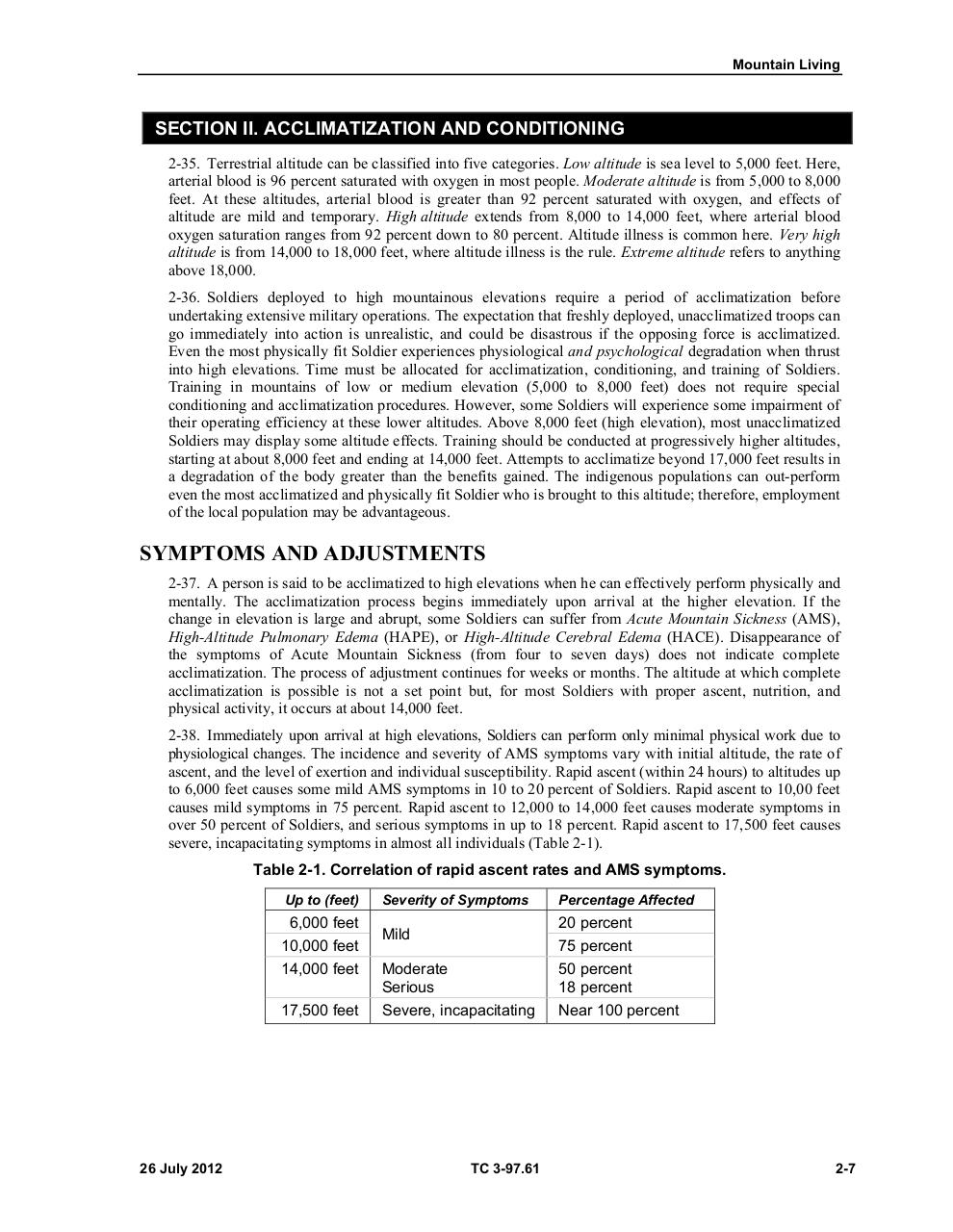
2-38. Immediately upon arrival at high elevations, Soldiers can perform only minimal physical work due to
physiological changes. The incidence and severity of AMS symptoms vary with initial altitude, the rate of
ascent, and the level of exertion and individual susceptibility. Rapid ascent (within 24 hours) to altitudes up
to 6,000 feet causes some mild AMS symptoms in 10 to 20 percent of Soldiers. Rapid ascent to 10,00 feet
causes mild symptoms in 75 percent. Rapid ascent to 12,000 to 14,000 feet causes moderate symptoms in
over 50 percent of Soldiers, and serious symptoms in up to 18 percent. Rapid ascent to 17,500 feet causes
severe, incapacitating symptoms in almost all individuals (Table 2-1).
Table 2-1. Correlation of rapid ascent rates and AMS symptoms.
Up to (feet)
6,000 feet
10,000 feet
14,000 feet
17,500 feet
26 July 2012
Severity of Symptoms
Mild
Moderate
Serious
Severe, incapacitating
TC 3-97.61
Percentage Affected
20 percent
75 percent
50 percent
18 percent
Near 100 percent
2-7