
FuturENVIRO Noviembre .pdf
Vista previa de texto
Pre-tratamiento
Pretreatment
Es común para ambos tratamientos: TPC y TPQ, ésta etapa tiene
como objetivo remover de la corriente la basura, los sólidos gruesos
o pesados así como eliminar grasa y aceites. Está compuesto por
la obra de toma y protección; con 10 rejillas ejillas de desbaste con
un paso de 76,2 mm con cuchara bivalva anfibia de 2 m3, además
cuenta con 10 rejillas gruesas automáticas con un paso de 35 mm.
Además 20 rejillas finas automáticas con paso de 6 mm y 16 unidades de desarenado – desengrasado con lavado de arenas y sistema
de concentración de flotantes y grasas. La producción de residuos
y arenas será de 100.000 ton/año con destino relleno a sanitario.
This stage is common for the two treatment processes (TPC
and TPQ) and has the aim of removing waste, coarse and
heavy solids, grease and oils from the raw water. Pretreatment
comprises the intake and protection structure; with 10 filter
screens with a passage size of 76.2 mm, an amphibious
clamshell grab, 10 automatic coarse filtering bar screens with
a passage size of 35 mm. It also features 20 automatic screens
for fine filtering, with a passage size of 6 mm, 16 degritterdegreasers, and a floating solids and grease concentration
system. 100,000 ton/annum of waste and grit will be generated
and this will be sent to landfill.
Conventional Processes Train
(TPC)
PTAR Atotonilco (México D.F.) | Atotonilco WWTP (Mexico D.F.)
WATER TREATMENT LINES
LÍNEAS DE TRATAMIENTO DE AGUA
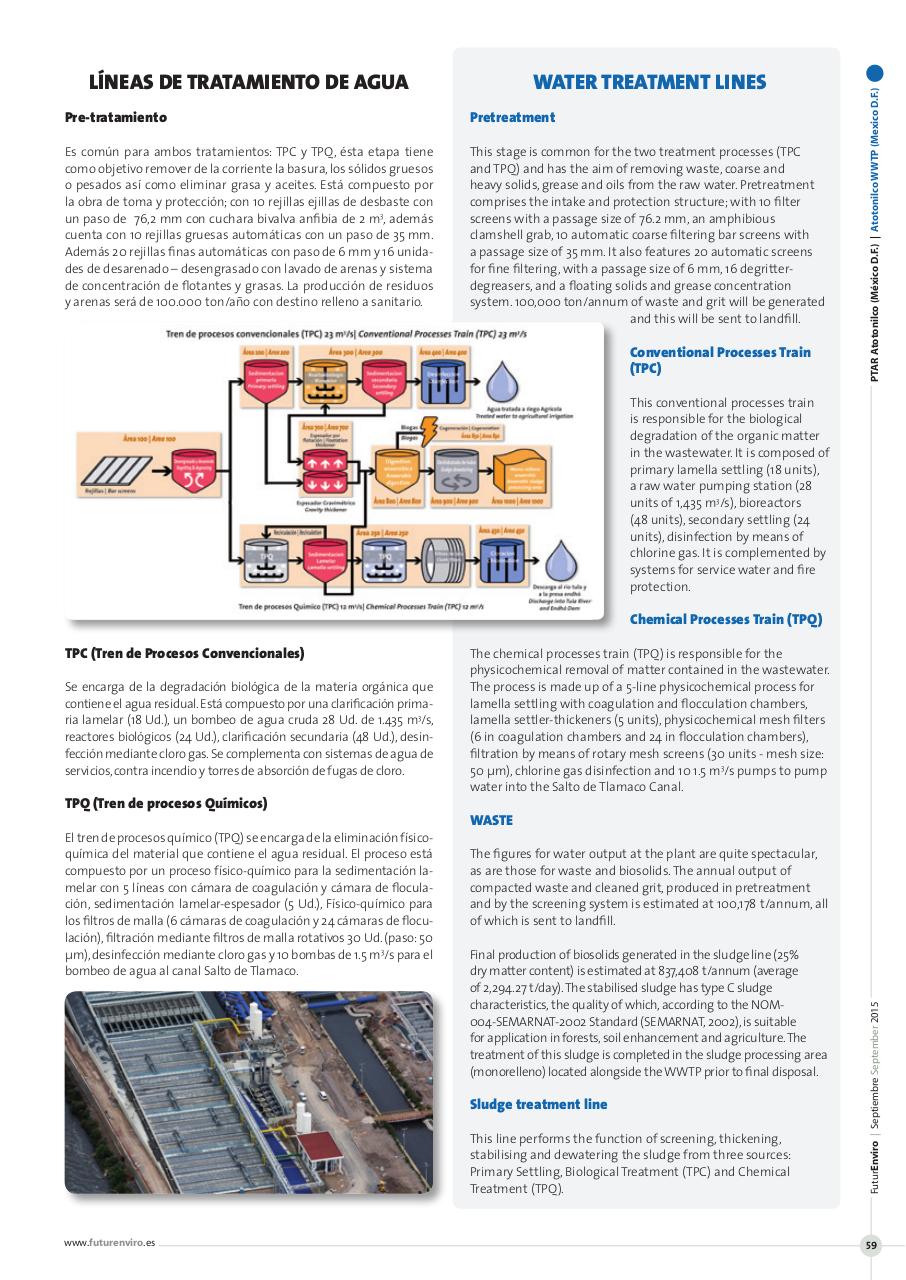
This conventional processes train
is responsible for the biological
degradation of the organic matter
in the wastewater. It is composed of
primary lamella settling (18 units),
a raw water pumping station (28
units of 1,435 m3/s), bioreactors
(48 units), secondary settling (24
units), disinfection by means of
chlorine gas. It is complemented by
systems for service water and fire
protection.
Chemical Processes Train (TPQ)
Se encarga de la degradación biológica de la materia orgánica que
contiene el agua residual. Está compuesto por una clarificación primaria lamelar (18 Ud.), un bombeo de agua cruda 28 Ud. de 1.435 m3/s,
reactores biológicos (24 Ud.), clarificación secundaria (48 Ud.), desinfección mediante cloro gas. Se complementa con sistemas de agua de
servicios, contra incendio y torres de absorción de fugas de cloro.
TPQ (Tren de procesos Químicos)
El tren de procesos químico (TPQ) se encarga de la eliminación físicoquímica del material que contiene el agua residual. El proceso está
compuesto por un proceso físico-químico para la sedimentación lamelar con 5 líneas con cámara de coagulación y cámara de floculación, sedimentación lamelar-espesador (5 Ud.), Físico-químico para
los filtros de malla (6 cámaras de coagulación y 24 cámaras de floculación), filtración mediante filtros de malla rotativos 30 Ud. (paso: 50
µm), desinfección mediante cloro gas y 10 bombas de 1.5 m3/s para el
bombeo de agua al canal Salto de Tlamaco.
The chemical processes train (TPQ) is responsible for the
physicochemical removal of matter contained in the wastewater.
The process is made up of a 5-line physicochemical process for
lamella settling with coagulation and flocculation chambers,
lamella settler-thickeners (5 units), physicochemical mesh filters
(6 in coagulation chambers and 24 in flocculation chambers),
filtration by means of rotary mesh screens (30 units - mesh size:
50 µm), chlorine gas disinfection and 10 1.5 m3/s pumps to pump
water into the Salto de Tlamaco Canal.
WASTE
The figures for water output at the plant are quite spectacular,
as are those for waste and biosolids. The annual output of
compacted waste and cleaned grit, produced in pretreatment
and by the screening system is estimated at 100,178 t/annum, all
of which is sent to landfill.
Final production of biosolids generated in the sludge line (25%
dry matter content) is estimated at 837,408 t/annum (average
of 2,294.27 t/day). The stabilised sludge has type C sludge
characteristics, the quality of which, according to the NOM004-SEMARNAT-2002 Standard (SEMARNAT, 2002), is suitable
for application in forests, soil enhancement and agriculture. The
treatment of this sludge is completed in the sludge processing area
(monorelleno) located alongside the WWTP prior to final disposal.
Sludge treatment line
This line performs the function of screening, thickening,
stabilising and dewatering the sludge from three sources:
Primary Settling, Biological Treatment (TPC) and Chemical
Treatment (TPQ).
www.futurenviro.es
FuturEnviro | Septiembre September 2015
TPC (Tren de Procesos Convencionales)
59