
Magnet 8TipsforPresentingDigitalEvidence.pdf
Vista previa de texto
When evaluating digital forensics tools, look for
one that helps:
Recover history records, dates and times of
webpage visits.
Rebuild web pages as the viewer saw them
when they conducted their search.
Plot recovered timestamp data on a visual
timeline, so the judge and jury can quickly
grasp a chronological series of events.
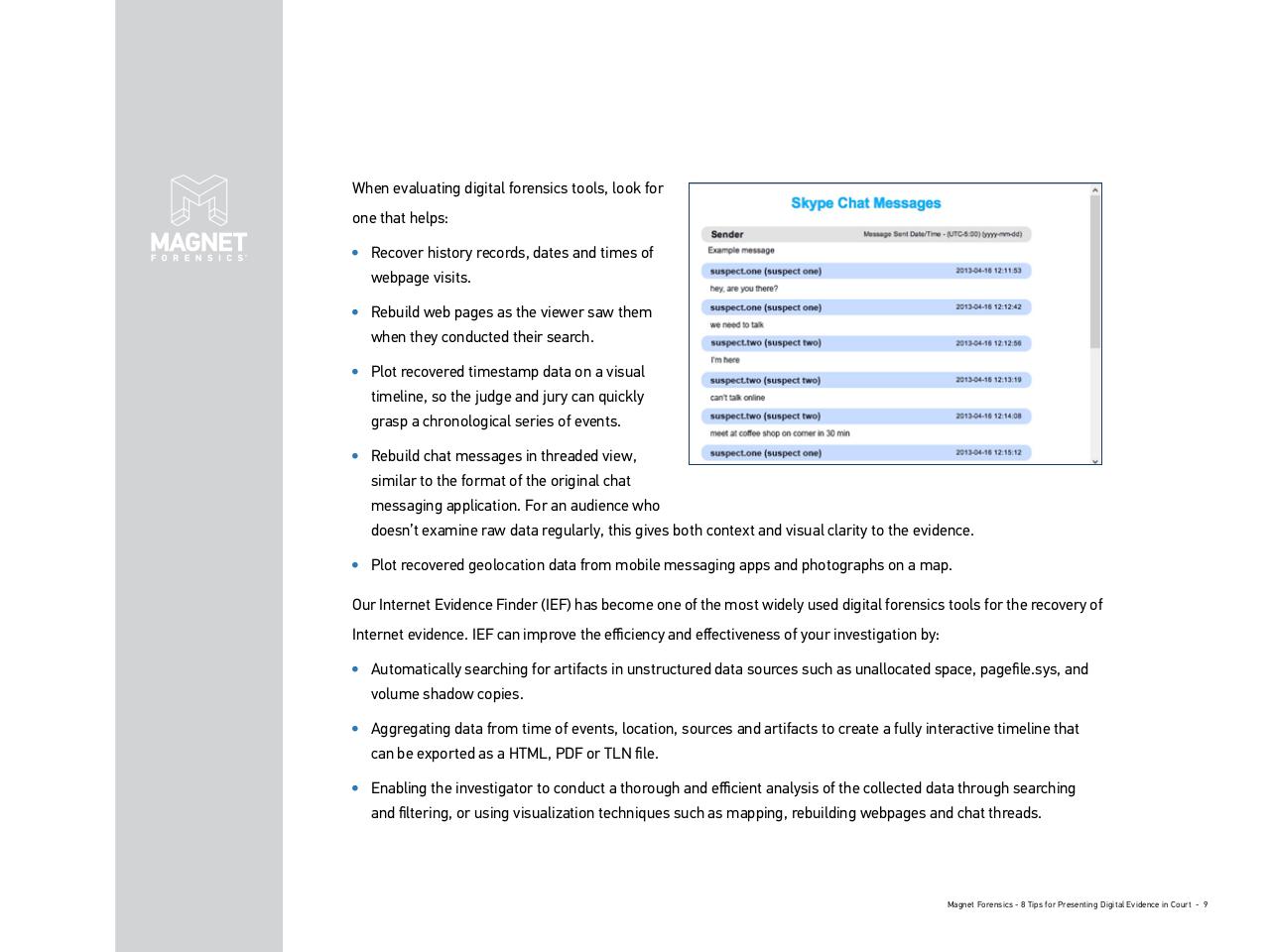
Rebuild chat messages in threaded view,
similar to the format of the original chat
messaging application. For an audience who
doesn’t examine raw data regularly, this gives both context and visual clarity to the evidence.
Plot recovered geolocation data from mobile messaging apps and photographs on a map.
Our Internet Evidence Finder (IEF) has become one of the most widely used digital forensics tools for the recovery of
Internet evidence. IEF can improve the efficiency and effectiveness of your investigation by:
Automatically searching for artifacts in unstructured data sources such as unallocated space, pagefile.sys, and
volume shadow copies.
Aggregating data from time of events, location, sources and artifacts to create a fully interactive timeline that
can be exported as a HTML, PDF or TLN file.
Enabling the investigator to conduct a thorough and efficient analysis of the collected data through searching
and filtering, or using visualization techniques such as mapping, rebuilding webpages and chat threads.
Magnet Forensics - 8 Tips for Presenting Digital Evidence in Court - 9