
ZARZA 2012.pdf
Vista previa de texto
VIDA ESCOLAR
CHARLES DICKENS
Fast Facts
W
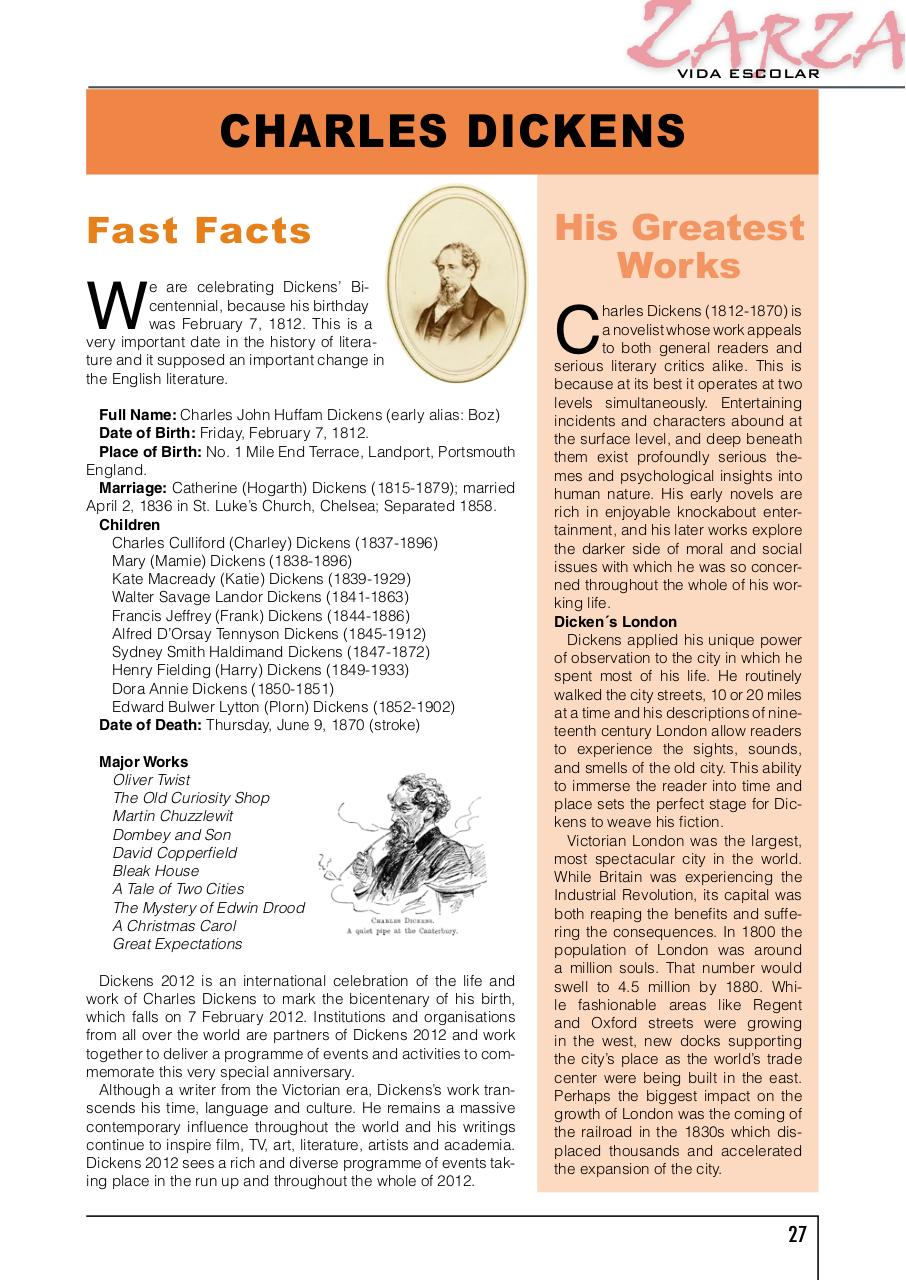
e are celebrating Dickens’ Bicentennial, because his birthday
was February 7, 1812. This is a
very important date in the history of literature and it supposed an important change in
the English literature.
Full Name: Charles John Huffam Dickens (early alias: Boz)
Date of Birth: Friday, February 7, 1812.
Place of Birth: No. 1 Mile End Terrace, Landport, Portsmouth
England.
Marriage: Catherine (Hogarth) Dickens (1815-1879); married
April 2, 1836 in St. Luke’s Church, Chelsea; Separated 1858.
Children
Charles Culliford (Charley) Dickens (1837-1896)
Mary (Mamie) Dickens (1838-1896)
Kate Macready (Katie) Dickens (1839-1929)
Walter Savage Landor Dickens (1841-1863)
Francis Jeffrey (Frank) Dickens (1844-1886)
Alfred D’Orsay Tennyson Dickens (1845-1912)
Sydney Smith Haldimand Dickens (1847-1872)
Henry Fielding (Harry) Dickens (1849-1933)
Dora Annie Dickens (1850-1851)
Edward Bulwer Lytton (Plorn) Dickens (1852-1902)
Date of Death: Thursday, June 9, 1870 (stroke)
Major Works
Oliver Twist
The Old Curiosity Shop
Martin Chuzzlewit
Dombey and Son
David Copperfield
Bleak House
A Tale of Two Cities
The Mystery of Edwin Drood
A Christmas Carol
Great Expectations
Dickens 2012 is an international celebration of the life and
work of Charles Dickens to mark the bicentenary of his birth,
which falls on 7 February 2012. Institutions and organisations
from all over the world are partners of Dickens 2012 and work
together to deliver a programme of events and activities to commemorate this very special anniversary.
Although a writer from the Victorian era, Dickens’s work transcends his time, language and culture. He remains a massive
contemporary influence throughout the world and his writings
continue to inspire film, TV, art, literature, artists and academia.
Dickens 2012 sees a rich and diverse programme of events taking place in the run up and throughout the whole of 2012.
His Greatest
Works
C
harles Dickens (1812-1870) is
a novelist whose work appeals
to both general readers and
serious literary critics alike. This is
because at its best it operates at two
levels simultaneously. Entertaining
incidents and characters abound at
the surface level, and deep beneath
them exist profoundly serious themes and psychological insights into
human nature. His early novels are
rich in enjoyable knockabout entertainment, and his later works explore
the darker side of moral and social
issues with which he was so concerned throughout the whole of his working life.
Dicken´s London
Dickens applied his unique power
of observation to the city in which he
spent most of his life. He routinely
walked the city streets, 10 or 20 miles
at a time and his descriptions of nineteenth century London allow readers
to experience the sights, sounds,
and smells of the old city. This ability
to immerse the reader into time and
place sets the perfect stage for Dickens to weave his fiction.
Victorian London was the largest,
most spectacular city in the world.
While Britain was experiencing the
Industrial Revolution, its capital was
both reaping the benefits and suffering the consequences. In 1800 the
population of London was around
a million souls. That number would
swell to 4.5 million by 1880. While fashionable areas like Regent
and Oxford streets were growing
in the west, new docks supporting
the city’s place as the world’s trade
center were being built in the east.
Perhaps the biggest impact on the
growth of London was the coming of
the railroad in the 1830s which displaced thousands and accelerated
the expansion of the city.
27