
Digital citizen empowerment a sytematic literature review fusionado.pdf
Vista previa de texto
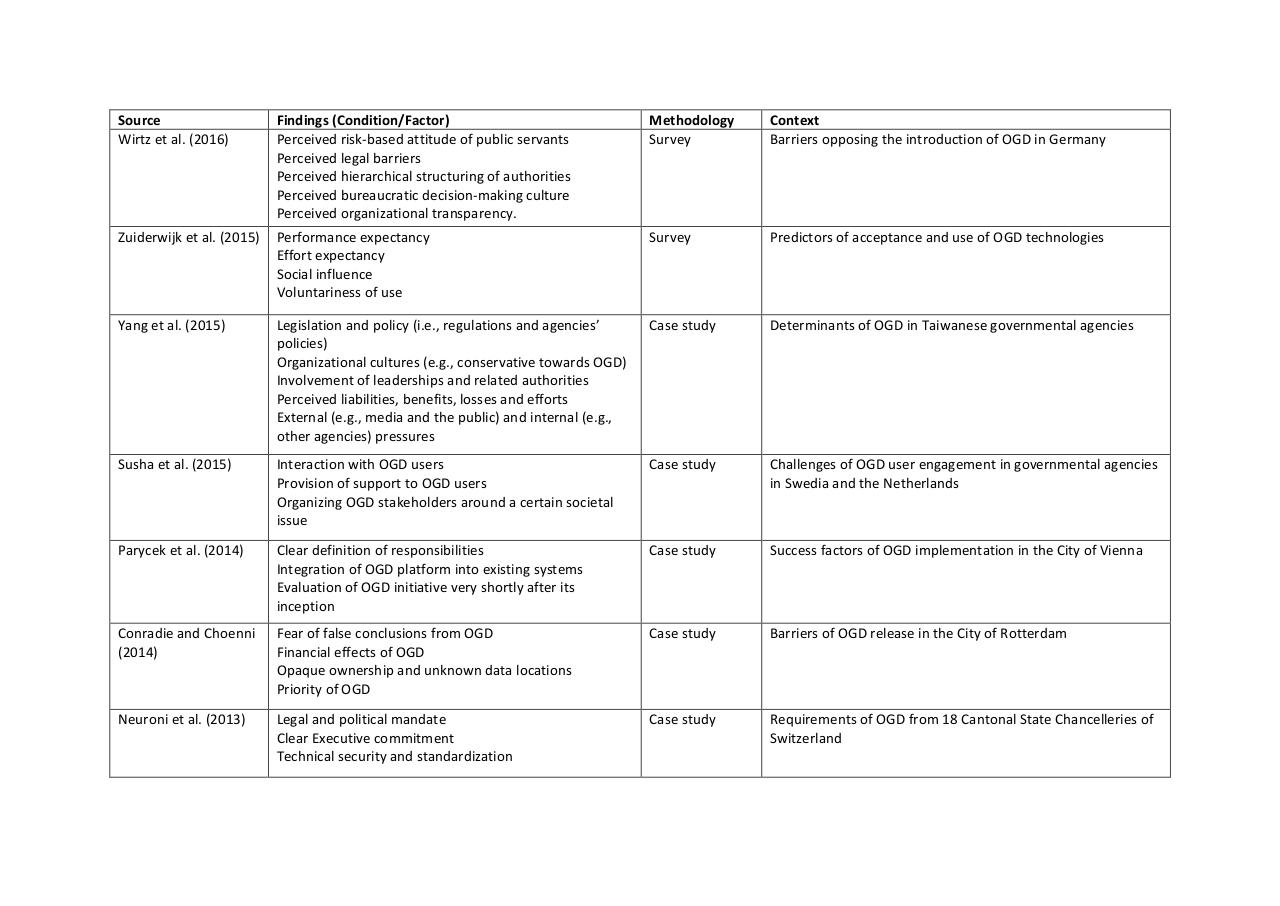
Source
Wirtz et al. (2016)
Findings (Condition/Factor)
Perceived risk-based attitude of public servants
Perceived legal barriers
Perceived hierarchical structuring of authorities
Perceived bureaucratic decision-making culture
Perceived organizational transparency.
Methodology
Survey
Context
Barriers opposing the introduction of OGD in Germany
Zuiderwijk et al. (2015)
Performance expectancy
Effort expectancy
Social influence
Voluntariness of use
Survey
Predictors of acceptance and use of OGD technologies
Yang et al. (2015)
Legislation and policy (i.e., regulations and agencies’
policies)
Organizational cultures (e.g., conservative towards OGD)
Involvement of leaderships and related authorities
Perceived liabilities, benefits, losses and efforts
External (e.g., media and the public) and internal (e.g.,
other agencies) pressures
Case study
Determinants of OGD in Taiwanese governmental agencies
Susha et al. (2015)
Interaction with OGD users
Provision of support to OGD users
Organizing OGD stakeholders around a certain societal
issue
Case study
Challenges of OGD user engagement in governmental agencies
in Swedia and the Netherlands
Parycek et al. (2014)
Clear definition of responsibilities
Integration of OGD platform into existing systems
Evaluation of OGD initiative very shortly after its
inception
Case study
Success factors of OGD implementation in the City of Vienna
Conradie and Choenni
(2014)
Fear of false conclusions from OGD
Financial effects of OGD
Opaque ownership and unknown data locations
Priority of OGD
Case study
Barriers of OGD release in the City of Rotterdam
Neuroni et al. (2013)
Legal and political mandate
Clear Executive commitment
Technical security and standardization
Case study
Requirements of OGD from 18 Cantonal State Chancelleries of
Switzerland