
Digital citizen empowerment a sytematic literature review fusionado.pdf
Vista previa de texto
The Use of Open Government Data to Citizen Empowerment
- the case of "Caring For My Neighborhood"
Gisele S. Craveiro, Jorge A. S. Machado, Jutta S. Machado
Colaboratory of Development and Participation - University of São Paulo
giselesc@usp.br, machado@usp.br, jutta@usp.br
What problem was addressed and why it is important
Scientific literature also presents and discusses challenges and barriers to an effective citizen
empowerment, specially among the most marginalized ones. Unequal distribution of skills,
resources, and time have a big impact on who is making use of Open Government Data (OGD). The
reach they can have using OGD, as data literacy and skills of individual groups of citizens, and their
access to technology, should also be considered. Although it is argued that Open Government Data
have the ability to facilitate networks of collaboration and co-creation that produce citizen
empowerment, there is a lack in the literature about related OGD impacts and outcomes.
It is also fundamental to understand the ecosystem of data producers, infomediaries, and users: not
only each one's roles, but also the relationships among them which may contribute to, or inhibit,
citizen empowerment. But there is still a lack in scientific literature the assessment of civic
applications built on top of open government data.
The goal of this work is to analyze the output, outcomes, and/or impacts that a network of
organizations, institutions and individuals derives from OGD through a case study in the city of São
Paulo focusing on a budget transparency tool used by unskilled citizens. The Theory of Change
approach can sharpen the planning and implementation of an initiative, and this work adopts the
definitions of inputs, activities, outputs, outcomes, and impacts from the Outcome Mapping
approach.
Figure 1: Geocoded Budget Visualization with the help of
Caring for My Neighborhood tool
Available at http://www.cuidando.org.br
How it was addressed
The tool was presented to almost 200 people (social leaders of grassroots movements and
public transparency advocates). They were asked to perform some activities with the tool. We
also performed in-depth interviews with a sample of participants.
Additionally, we carried out interviews with municipal officials responsible for policy-making in
the areas of access to information (the Municipal Board of Control), planning, and budgeting
(the Municipal Planning , Budget and Management).
In addition to the questionnaires and interviews, two technical visits and six observation visits
were carried out.
Figure 2: Steps to impact.
Findings and Implications
The results collected from interviews and
observations showed that the main outcomes and
impacts could be summarized as follow: the tool
influenced public managers perceptions about open
data and budget, it started the debate on
transparency and open data in local public
administration, raised citizens awareness on
budgetary data.
A preliminary analysis could gather the project
outputs and outcomes in four main impact areas:
●
Influence on citizens
●
Institutional influences
●
Media response
●
Influence on Civil Society Organization
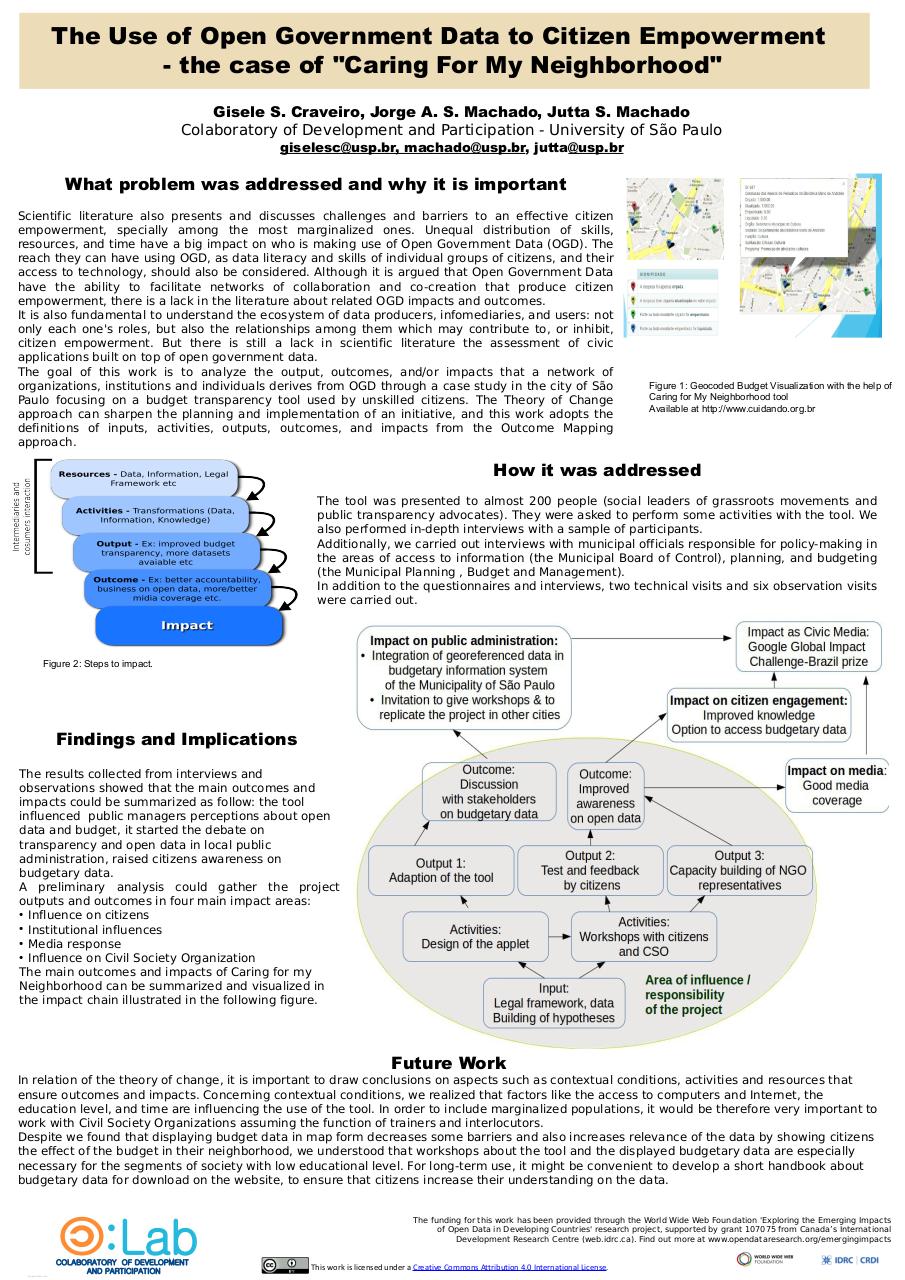
The main outcomes and impacts of Caring for my
Neighborhood can be summarized and visualized in
the impact chain illustrated in the following figure.
Future Work
In relation of the theory of change, it is important to draw conclusions on aspects such as contextual conditions, activities and resources that
ensure outcomes and impacts. Concerning contextual conditions, we realized that factors like the access to computers and Internet, the
education level, and time are influencing the use of the tool. In order to include marginalized populations, it would be therefore very important to
work with Civil Society Organizations assuming the function of trainers and interlocutors.
Despite we found that displaying budget data in map form decreases some barriers and also increases relevance of the data by showing citizens
the effect of the budget in their neighborhood, we understood that workshops about the tool and the displayed budgetary data are especially
necessary for the segments of society with low educational level. For long-term use, it might be convenient to develop a short handbook about
budgetary data for download on the website, to ensure that citizens increase their understanding on the data.
:Lab
COLABORATORY OF DEVELOPMENT
AND PARTICIPATION
View publication stats
The funding for this work has been provided through the World Wide Web Foundation 'Exploring the Emerging Impacts
of Open Data in Developing Countries' research project, supported by grant 107075 from Canada’s International
Development Research Centre (web.idrc.ca). Find out more at www.opendataresearch.org/emergingimpacts
This work is licensed under a Creative Commons Attribution 4.0 International License.