
Masterarbeit SS 1.2 Final.pdf
Vista previa de texto
FOOD STIMULI AND GENDER
22
concerning sweet and savory foods (H1a and H1b), the high-calorie category was subdivided
into two groups: sweet and non-sweet.
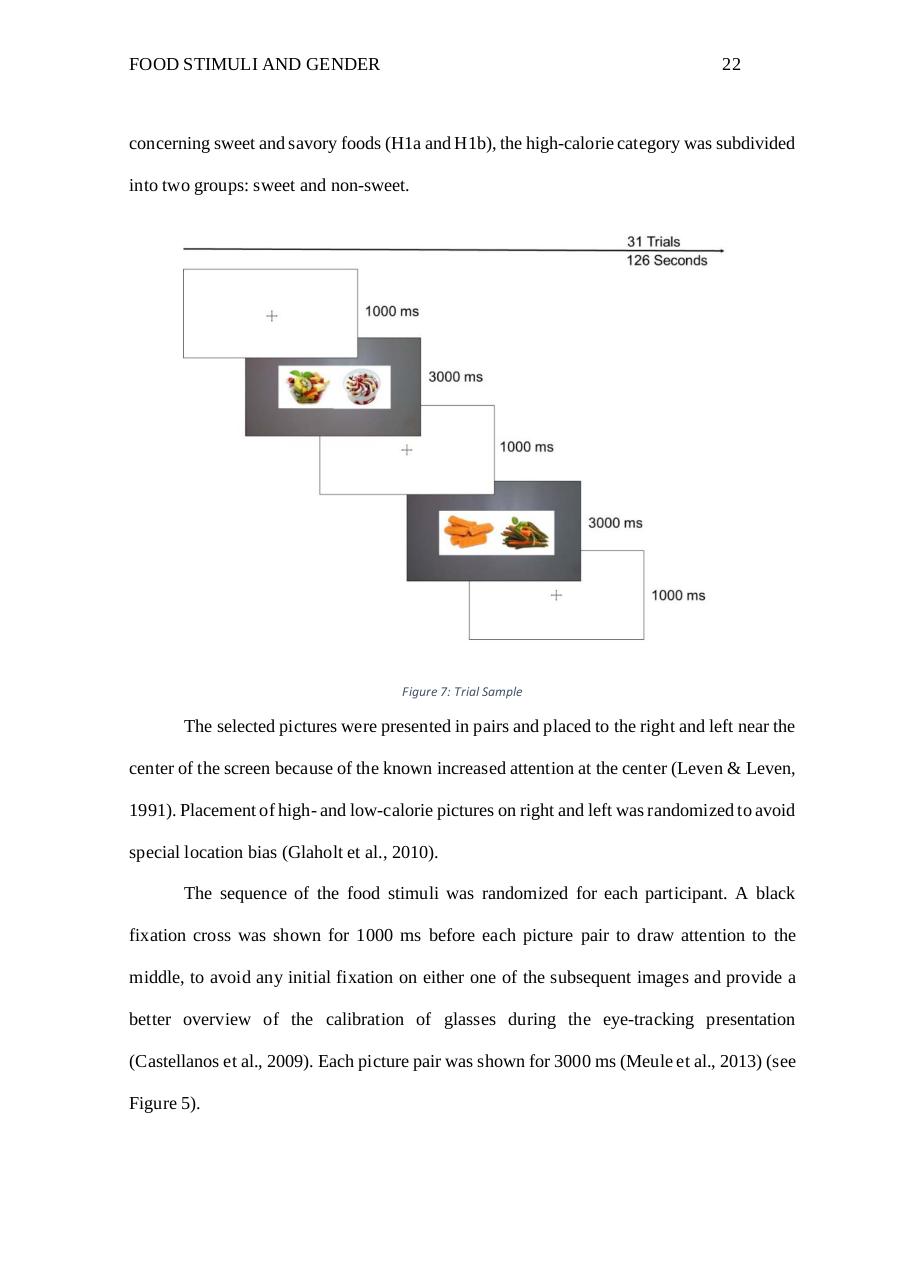
Figure 7: Trial Sample
The selected pictures were presented in pairs and placed to the right and left near the
center of the screen because of the known increased attention at the center (Leven & Leven,
1991). Placement of high- and low-calorie pictures on right and left was randomized to avoid
special location bias (Glaholt et al., 2010).
The sequence of the food stimuli was randomized for each participant. A black
fixation cross was shown for 1000 ms before each picture pair to draw attention to the
middle, to avoid any initial fixation on either one of the subsequent images and provide a
better overview of the calibration of glasses during the eye-tracking presentation
(Castellanos et al., 2009). Each picture pair was shown for 3000 ms (Meule et al., 2013) (see
Figure 5).